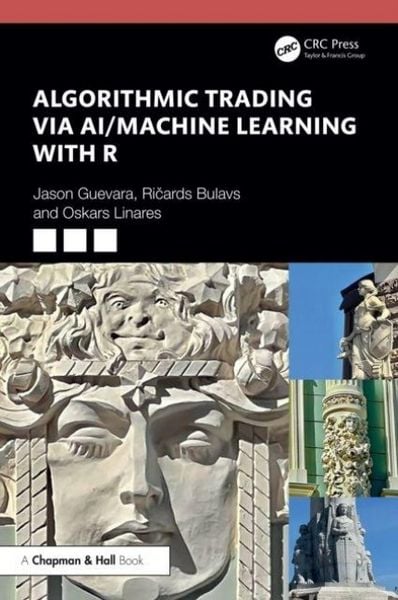
Produktbild: Algorithmic Trading via AI/Machine Learning with R
Vorbesteller Neu

Algorithmic Trading via AI/Machine Learning with R

101,99 €

inkl. gesetzl. MwSt., Versandkostenfrei


Beschreibung

Produktdetails

Einband

Taschenbuch

Erscheinungsdatum

06.07.2026

Verlag

Taylor & Francis

Seitenzahl

308

Maße (L/B)

23,4/15,6 cm

Gewicht

650 g

Sprache

Englisch

ISBN

978-1-04-126468-2

Beschreibung

Produktdetails

Einband

Taschenbuch

Erscheinungsdatum

06.07.2026

Verlag

Taylor & Francis

Seitenzahl

308

Maße (L/B)

23,4/15,6 cm

Gewicht

650 g

Sprache

Englisch

ISBN

978-1-04-126468-2

Herstelleradresse

Libri GmbH
Europaallee 1
36244 Bad Hersfeld
DE

Email: gpsr@libri.de

Kundinnen und Kunden meinen

0 Bewertungen

Informationen zu Bewertungen

Zur Abgabe einer Bewertung ist eine Anmeldung im Konto notwendig. Die Authentizität der Bewertungen wird von uns nicht überprüft. Wir behalten uns vor, Bewertungstexte, die unseren Richtlinien widersprechen, entsprechend zu kürzen oder zu löschen.

Die Bewertungen sind nach Format, Anzahl Sterne und Datum sortiert.

Verfassen Sie die erste Bewertung zu diesem Artikel

Helfen Sie anderen Kund*innen durch Ihre Meinung

Kundinnen und Kunden meinen

0 Bewertungen filtern

Die Leseprobe wird geladen.
  • Produktbild: Algorithmic Trading via AI/Machine Learning with R
  • Preface List of Figures List of Tables Listings 1 Key AI/ML R Packages 1.1 Introduction 1.2 Algorithmic Trading and AI/ML Packages 1.2.1 General ML Frameworks 1.2.2 Deep Learning 1.2.3 Bayesian Methods 1.2.4 Explainability 1.2.5 Algorithmic Trading Packages 1.2.6 Strategy & Backtesting 1.2.7 Risk & Performance 1.2.8 Execution & Integration 1.2.9 Conclusion 1.3 A Modern Comparative Analysis of Python vs R for Algorithmic Trading 1.3.1 Introduction 1.3.2 Python Ecosystem and Libraries 1.3.3 R Ecosystem and Libraries (Modern Workflow) 1.3.4 Conclusion and Recommendation 2 Market Data Acquisition 2.1 Introduction 2.2 Core Market Data Packages 2.2.1 quantmod 2.2.2 tidyquant 2.2.3 IBrokers 2.2.4 Charles Schwab (Trader) API 2.2.5 Rblpapi 2.2.6 alphavantager 2.2.7 Quandl 2.2.8 crypto2, cryptowatchR 2.2.9 xts and zoo 2.2.10 data.table 2.2.11 Conclusion 2.3 Data Storage Solutions 2.3.1 Introduction 2.3.2 SQLite and PostgreSQL 2.3.3 Parquet, Feather, and FST 2.3.4 Cloud Storage and Data Lakes 2.3.5 Hybrid Approach 2.3.6 MongoDB 2.3.7 DuckDB 2.3.8 Conclusion and Recommendations 2.4 Data Wrangling Packages for Algorithmic Trading 2.4.1 Core Time-Series Structures 2.4.2 High-Performance Wrangling 2.4.3 Tidy Financial Wrangling 2.4.4 Date and Text Utilities 2.5 Conclusion 3 Trading Models & Strategy Design 3.1 Trend Following 3.1.1 Moving Averages and Crossovers 3.1.2 Commentary 3.2 Mean Reversion 3.2.1 Bollinger Bands and Thresholds 3.2.2 Commentary 3.3 Statistical Arbitrage (Pairs Trading) 3.3.1 Pairs Trading 3.3.2 Commentary 3.4 Cyclical 3.4.1 Fast Fourier Transform (FFT) 3.4.2 Spectral Leakage Reduction 3.4.3 Commentary 3.5 Cluster 3.5.1 Frequency Distribution Histogram 3.5.2 Commentary 3.6 Chart Patterns 3.6.1 Double Top/Bottom 3.6.2 Commentary 3.7 Seasonality 3.7.1 Market Inefficiencies 3.7.2 Commentary 3.8 Gaps Up/Down 3.8.1 Price Gaps 3.8.2 Commentary 3.9 Time Series 3.9.1 ARIMA Models 3.9.2 Commentary 3.10 Price Shocks 3.10.1 Relative Strength Index (RSI) 3.10.2 Commentary 3.11 Volatility Breakout 3.11.1 Volatility Breakout Signals 3.11.2 Commentary 3.12 Machine Learning-Based 3.12.1 Decision Tree Classifier 3.12.2 Commentary 4 Performance Testing 4.1 Backtesting with Historical Data I 4.1.1 Introduction 4.1.2 Backtesting in R 4.1.3 Performance Backtest 4.1.4 Limitations of Backtesting 4.2 Backtesting with Historical Data II 4.2.1 Overview 4.2.2 Trading Logic 4.2.3 Modeling Assumptions 4.2.4 Performance Interpretation 4.2.5 Strategy Results 4.2.6 Benchmark Results 4.2.7 Key Definitions 4.2.8 Conclusion 4.3 Forward Testing: Assessing Algorithm Performance in Real-Time 4.3.1 Introduction 4.3.2 Real-Time Data: Acquisition, Processing, and Storage 4.3.3 Forward Testing: Methods and Best Practices 4.3.4 Evaluating Forward-Test Outcomes 4.4 Evaluating Performance: Metrics and Methods 4.5 Managing Risk: Strategies for Control and Mitigation 5 AI/ML for Finance 5.1 Supervised Learning 5.1.1 Logistic Regression Results 5.1.2 Random Forest Interpretation 5.1.3 Support Vector Regression Interpretation 5.1.4 Bias-Variance Tradeoff: A Key to Model Performance 5.1.5 Cross-Validation Techniques for Model Evaluation 5.1.6 Balancing Complexity and Simplicity: Overfitting and Under-fitting in Financial Models 5.1.7 Lasso Interpretation 5.1.8 Optimizing Model Performance through Hyperparameter Tuning 5.1.9 Ensemble Learning for Financial Prediction 5.2 Unsupervised Learning (Clustering) 5.2.1 K-Means 5.2.2 Hierarchical Clustering 5.3 Deep Learning (Neural Networks) 5.3.1 Feedforward Neural Network 5.3.2 Implementing Deep Learning with TensorFlow and Keras 6 Case Studies in AI/ML-Enhanced Trading Strategies 6.1 Introduction 6.2 Case Study 1: Momentum 6.3 Case Study 2: Mean Reversion 6.4 Case Study 3: Sentiment Analysis 6.5 Case Study 4: Portfolio Optimization 6.6 Case Study 5: Market-Making 6.7 Case Study 6: Stock Grouping 6.8 Case Study 7: Predicting Stock Trends 6.9 Case Study 8: PCA Application 6.10 Case Study 9: Unsupervised Portfolio Analysis 6.11 Case Study 10: Deep Learning Models 7 Getting Started with the Interactive Brokers TWS API 7.1 Introduction to R and RStudio 7.2 Installing R and RStudio 7.3 Configuring IB's Trader Workstation 7.4 Introduction to IBrokers Package (Core Methods) 7.4.1 twsConnect 7.4.2 isConnected 7.4.3 twsConnectionTime 7.4.4 reqAccountUpdates 7.4.5 reqCurrentTime 7.4.6 reqIds 7.4.7 twsContract 7.4.8 reqHistoricalData 7.4.9 reqMktData 7.4.10 reqMktDepth 7.4.11 reqRealTimeBars 7.4.12 placeOrder 7.4.13 cancelOrder 8 Algorithmic Trading: Automation and Monitoring 8.1 The Landscape of Algorithmic Trading 8.1.1 From Strategies to Systems 8.1.2 Building for Resilience 8.1.3 Tools, Education, and the Roadmap Ahead 8.1.4 The Reality of Success in Algorithmic Trading 8.2 Designing and Implementing a Trading Strategy 9 QuantRoom Videos & Scripts 9.1 Introduction 9.2 Interactive Brokers Videos & Scripts 9.3 Charles Schwab (Trader) API Videos & Scripts Appendix A Comparison of C++ TWS API and R IBrokers Package Appendix B The R C++ Application Programming Interface (API) Index