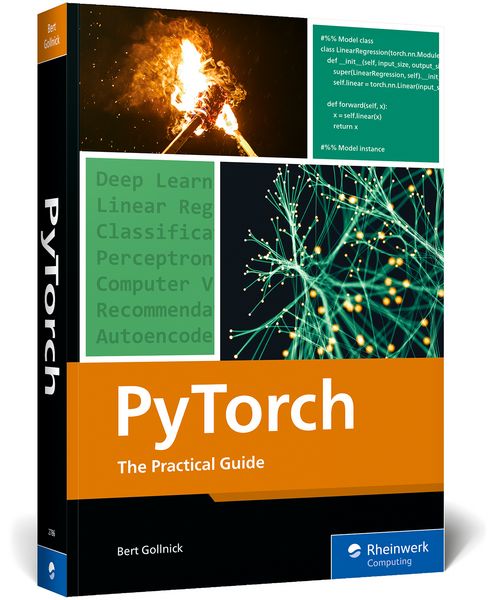
Produktbild: PyTorch

PyTorch The Practical Guide

59,95 €

inkl. gesetzl. MwSt., Versandkostenfrei


Beschreibung

Produktdetails

Einband

Taschenbuch

Erscheinungsdatum

05.05.2026

Verlag

Rheinwerk Publishing

Seitenzahl

415

Maße (L/B/H)

25,3/17,9/2,2 cm

Gewicht

730 g

Auflage

1

Sprache

Englisch

ISBN

978-1-4932-2786-0

Beschreibung

Produktdetails

Einband

Taschenbuch

Erscheinungsdatum

05.05.2026

Verlag

Rheinwerk Publishing

Seitenzahl

415

Maße (L/B/H)

25,3/17,9/2,2 cm

Gewicht

730 g

Auflage

1

Sprache

Englisch

ISBN

978-1-4932-2786-0

Herstelleradresse

Rheinwerk Verlag GmbH
Rheinwerkallee 4
53227 Bonn
DE

Email: service@rheinwerk-verlag.de

Kundinnen und Kunden meinen

0 Bewertungen

Informationen zu Bewertungen

Zur Abgabe einer Bewertung ist eine Anmeldung im Konto notwendig. Die Authentizität der Bewertungen wird von uns nicht überprüft. Wir behalten uns vor, Bewertungstexte, die unseren Richtlinien widersprechen, entsprechend zu kürzen oder zu löschen.

Die Bewertungen sind nach Format, Anzahl Sterne und Datum sortiert.

Verfassen Sie die erste Bewertung zu diesem Artikel

Helfen Sie anderen Kund*innen durch Ihre Meinung

Kundinnen und Kunden meinen

0 Bewertungen filtern

  • Produktbild: PyTorch
  • ... Preface ... 15

    ... Target Group ... 15

    ... Requirements ... 15

    ... Structure of the Book ... 16

    ... How to Use This Book ... 18

    ... Downloading Code and Additional Materials ... 18

    ... Preparing the System ... 19

    ... Acknowledgements ... 24

    ... Conventions Used in This Book ... 25

    1 ... Introduction to Deep Learning ... 27

    1.1 ... What is Deep Learning? ... 27

    1.2 ... What Can You Use Deep Learning For? ... 28

    1.3 ... How Does Deep Learning Work? ... 31

    1.4 ... Historical Development ... 33

    1.5 ... Perceptrons ... 34

    1.6 ... Network Structure and Layers ... 34

    1.7 ... Activation Functions ... 35

    1.8 ... Loss Functions ... 38

    1.9 ... Optimizers and Updating Parameters ... 40

    1.10 ... Tensor Handling ... 42

    1.11 ... Summary ... 50

    2 ... Creating Your First PyTorch Model ... 51

    2.1 ... Data Preparation ... 51

    2.2 ... Model Creation ... 60

    2.3 ... The Model Class and the Optimizer ... 68

    2.4 ... Batches ... 72

    2.5 ... Coding: Implementation of Dataset and DataLoader ... 76

    2.6 ... Loading and Saving a Model ... 80

    2.7 ... Data Sampling ... 83

    2.8 ... Summary ... 92

    3 ... Classification Models ... 93

    3.1 ... Classification Types ... 93

    3.2 ... Confusion Matrix ... 95

    3.3 ... Receiver Operator Characteristic Curve ... 97

    3.4 ... Coding: Binary Classification ... 99

    3.5 ... Coding: Multiclass Classification ... 112

    3.6 ... Summary ... 124

    4 ... Computer Vision ... 127

    4.1 ... How Do Models Handle Images? ... 128

    4.2 ... Network Architecture ... 129

    4.3 ... Coding: Image Classification ... 134

    4.4 ... Object Detection ... 163

    4.5 ... Semantic Segmentation ... 178

    4.6 ... Style Transfer ... 188

    4.7 ... Summary ... 197

    5 ... Recommendation Systems ... 199

    5.1 ... Theoretical Foundations ... 199

    5.2 ... Coding: Recommendation Systems ... 202

    5.3 ... Summary ... 218

    6 ... Autoencoders ... 219

    6.1 ... Architecture ... 220

    6.2 ... Coding: Autoencoder ... 220

    6.3 ... Variational Autoencoders ... 230

    6.4 ... Coding: Variational Autoencoder ... 231

    6.5 ... Summary ... 240

    7 ... Graph Neural Networks ... 241

    7.1 ... Introduction to Graph Theory ... 241

    7.2 ... Coding: Developing a Graph ... 246

    7.3 ... Coding: Training a Graph Neural Network ... 250

    7.4 ... Summary ... 259

    8 ... Time Series Forecasting ... 261

    8.1 ... Modeling Approaches ... 261

    8.2 ... Coding: Custom Model ... 266

    8.3 ... Coding: Using PyTorch Forecasting ... 280

    8.4 ... Summary ... 288

    9 ... Language Models ... 289

    9.1 ... Using Large Language Models with Python ... 290

    9.2 ... Model Parameters ... 304

    9.3 ... Model Selection ... 307

    9.4 ... Message Types ... 310

    9.5 ... Prompt Templates ... 311

    9.6 ... Chains ... 315

    9.7 ... Structured Outputs ... 317

    9.8 ... Deep Dive: How Do Transformers Work? ... 320

    9.9 ... Summary ... 327

    10 ... Pretrained Networks and Fine-Tuning ... 329

    10.1 ... Pretrained Networks with Hugging Face ... 329

    10.2 ... Transfer Learning ... 332

    10.3 ... Coding: Fine-Tuning a Computer Vision Model ... 335

    10.4 ... Coding: Fine-Tuning a Language Model ... 343

    10.5 ... Summary ... 348

    11 ... PyTorch Lightning ... 351

    11.1 ... PyTorch Versus PyTorch Lightning ... 351

    11.2 ... Coding: Model Training ... 352

    11.3 ... Callbacks ... 359

    11.4 ... Summary ... 362

    12 ... Model Evaluation, Logging, and Monitoring ... 363

    12.1 ... TensorBoard ... 363

    12.2 ... MLflow ... 372

    12.3 ... Weights & Biases: WandB ... 377

    12.4 ... Summary ... 384

    13 ... Deployment ... 385

    13.1 ... Deployment Strategies ... 385

    13.2 ... Local Deployment ... 387

    13.3 ... Heroku ... 393

    13.4 ... Microsoft Azure ... 399

    13.5 ... Summary ... 407

    ... The Author ... 409

    ... Index ... 411