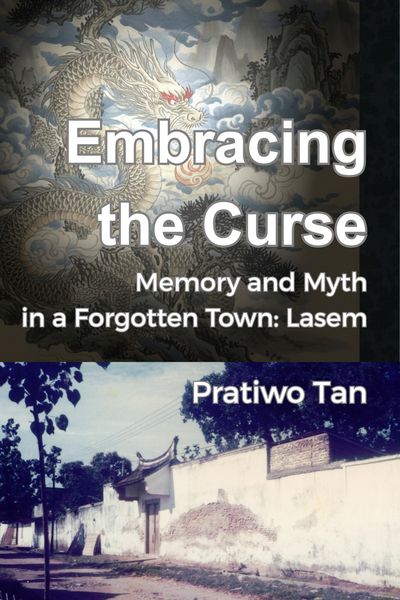
Embracing the Curse Memory and Myth in a Forgotten Town: Lasem
-
- Einzelkauf Download ausgewählt
-
Sprache:Englisch
2,99 €
inkl. gesetzl. MwSt.Beschreibung
Produktdetails
Format
ePUB
Kopierschutz
Ja
Family Sharing
Ja
Text-to-Speech
Ja
Erscheinungsdatum
07.01.2026
Verlag
Pratiwo TanSeitenzahl
(Printausgabe)
Dateigröße
1396 KB
Sprache
Englisch
EAN
9798233064883
Lasem is a small coastal town on the northern shore of Java, often described as quiet, marginal, and left behind by modern time. Yet beneath this apparent stillness lies a dense landscape of memory, myth, and unresolved history. Embracing the Curse: Memory and Myth in a Forgotten Town: Lasem explores the idea of a "curse" not as superstition, but as a metaphor for inherited memory, the weight of a past that continues to shape everyday life.
Rather than attempting to erase or romanticize this burden, the book asks what it means to live with it. To embrace the curse is to acknowledge that history does not simply disappear; it settles into streets, houses, rituals, silences, and stories passed from one generation to the next. Lasem is approached as a living archive, where memory is embedded not only in written records, but in architecture, spatial arrangements, material culture, and local myth.
The book weaves together historical research, architectural reading, and reflective observation. Narrow alleys, old Chinese houses, temples, cemeteries, and riverbanks become entry points into broader histories of maritime trade, Chinese settlement, colonial capitalism, and racialized violence. Lasem's urban fabric is examined through architectural research that treats buildings not merely as heritage objects, but as witnesses to hierarchy, fear, adaptation, and survival.
At the heart of the book appears the story of Mbah Nogo, an enigmatic local figure whose life becomes a lens through which Lasem's curse is most clearly felt. Marked by loss, stigma, and proximity to places associated with misfortune, Mbah Nogo does not attempt to flee the weight of history. Instead, he remains, inhabiting haunted spaces, tending to neglected sites, and accepting the burden others avoid. His fate embodies the book's central idea: that embracing the curse is not an act of resignation, but a form of endurance and ethical remembering.
The Chinese Indonesian community of Lasem forms a central thread in this narrative. Their domestic architecture, ritual life, and commercial networks are explored alongside moments of rupture, particularly during colonial rule and the Japanese occupation. The years of Japanese control emerge as a period of extreme disruption, marked by fear, scarcity, forced labor, and the collapse of earlier structures. These experiences left deep psychological and spatial scars that continue to shape how memory is spoken-or silenced-within the town.
Batik occupies a vital place in the book as both beauty and archive. The colors, patterns, and techniques of Lasem batik reflect long-standing exchanges between Chinese and Javanese traditions, revealing histories of gendered labor, resilience, and aesthetic synthesis. In batik, beauty persists amid hardship; patterns become carriers of memory, encoding stories of belief, survival, and continuity.
Myth and ghost stories are treated not as folklore detached from reality, but as emotional responses to historical trauma. Abandoned houses, old graves, and sites of violence generate narratives that keep the past present when official language fails. Silence itself is examined as a form of memory, an active strategy shaped by fear and survival, particularly in the aftermath of occupation and violence.
Embracing the Curse does not seek closure or simple conclusions, but invites readers to reflect on how places remember, how architecture and craft preserve memory, and how individuals like Mbah Nogo come to carry what a community cannot fully confront.
This book will appeal to readers interested in Southeast Asian history, Chinese Indonesian studies, batik and material culture, architectural research, cultural memory, and reflective explorations of place. Lasem emerges not as a town trapped by its past, but as one that continues to negotiate it, quietly, persistently, and with enduring complexity.
Kundinnen und Kunden meinen
Verfassen Sie die erste Bewertung zu diesem Artikel
Helfen Sie anderen Kund*innen durch Ihre Meinung
Kurze Frage zu unserer Seite
Vielen Dank für Ihr Feedback
Wir nutzen Ihr Feedback, um unsere Produktseiten zu verbessern. Bitte haben Sie Verständnis, dass wir Ihnen keine Rückmeldung geben können. Falls Sie Kontakt mit uns aufnehmen möchten, können Sie sich aber gerne an unseren Kund*innenservice wenden.
zum Kundenservice