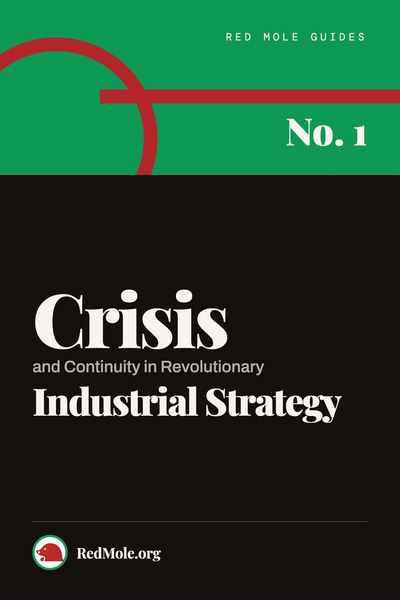
Crisis and Continuity in Revolutionary Industrial Strategy Red Mole Guides, #1
-
- Einzelkauf Download ausgewählt
-
Sprache:Englisch
4,49 €
inkl. gesetzl. MwSt.Beschreibung
Produktdetails
Format
ePUB
Kopierschutz
Ja
Family Sharing
Ja
Text-to-Speech
Ja
Erscheinungsdatum
01.01.2026
Verlag
Red MoleSeitenzahl
(Printausgabe)
Dateigröße
289 KB
Sprache
Englisch
EAN
9798233217036
In 1979 British trade unions had 13.2 million members, and 29,474,000 working days were lost to strikes. A workplace survey the next year counted 328,000 shop stewards. By 2025, union density was 22.4 per cent, and nobody counts workplace representatives any more: the last survey was in 2011.
What the revolutionary left did next is usually explained as a sequence. Rank-and-file organisation is what a rising level of struggle produces, so it cannot be built in a downturn, and revolutionaries must work instead through the structures that exist: the branch, the committee, the slate. This Guide calls that the downturn alibi, and shows it refuted inside the Socialist Workers Party's own founding documents. In autumn 1979 Tony Cliff described the Communist Party's Broad Left as a machine that won union elections by "placing the most minimal demand (the vote) on the stewards and branch committees", and listed its orientation to left officials among the causes of the decline. In 1983 he called it a swamp. A quarter of a century on, the British far left's industrial work runs through that very form.
Twenty-six documents, in extract, let the reader test that. The rank-and-file strategy in its own words, in Steve Jefferys' balance sheet of 1975 and the Fourth International's Turin industrial conference of 1969. The downturn thesis at length, beside a Manchester factory occupation that built rank-and-file organisation in its worst year. Two cases where the tradition split on how to vote: the Teamsters, whose reform caucus outlived the president it elected, and Comisiones Obreras, where power was concentrated without a penny going missing. Then Britain, from the Liverpool dockers to the strike wave of 2022, and the same argument from Morocco, Genoa and Lisbon.
The conclusion is not that union elections do not matter. It is that the fixed point is never the ballot but the assembly, and that a strategy which asks a member for a vote will get a vote.
Cliff, Jefferys, Choonara, McIlroy, Conway, Tucker and Eidlin among others.
Noch keine Bewertungen vorhanden
Verfassen Sie die erste Bewertung zu diesem Artikel
Helfen Sie anderen Kundinnen und Kunden durch Ihre Meinung.
Kurze Frage zu unserer Seite
Vielen Dank für Ihr Feedback
Wir nutzen Ihr Feedback, um unsere Produktseiten zu verbessern. Bitte haben Sie Verständnis, dass wir Ihnen keine Rückmeldung geben können. Falls Sie Kontakt mit uns aufnehmen möchten, können Sie sich aber gerne an unseren Kund*innenservice wenden.
zum Kundenservice