Beschreibung
Produktdetails
Format
Kopierschutz
Nein
Family Sharing
Nein
Text-to-Speech
Nein
Erscheinungsdatum
01.01.2026
Herausgeber
Ariane L. Herrick + weitereVerlag
Springer Nature SwitzerlandSeitenzahl
316 (Printausgabe)
Dateigröße
22646 KB
Sprache
Englisch
EAN
9783032039705
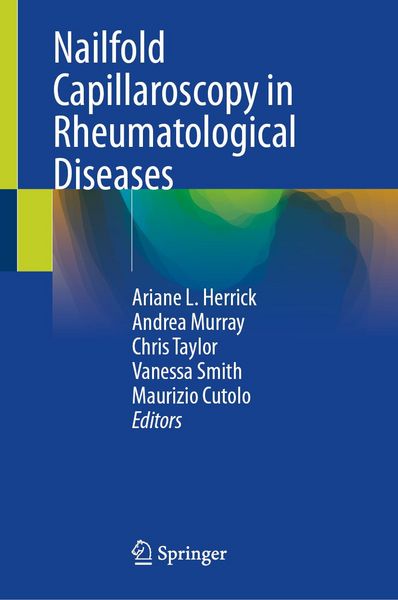
Nailfold capillaroscopy allows non-invasive assessment of the finger microvasculature. At the nailfold, capillaries run parallel rather than perpendicular to the skin surface, allowing their structure to be visualised under magnification.
The main clinical indication for nailfold capillaroscopy is the assessment of the patient with Raynaud's phenomenon (RP). Normal nailfold capillaries are reassuring, consistent with primary ('benign') RP, whereas abnormal capillaries (dilated capillaries, reduced capillary density) raise suspicion of an underlying systemic sclerosis-spectrum disorder. Although the significance of abnormal nailfold capillaries was recognised over 50 years ago, only within the last 20 years has there been a surge of interest in capillaroscopy, fuelled by the recognition that abnormal nailfold capillaries are an independent risk factor for development of systemic sclerosis and by abnormal nailfold capillaries being included in the 2013 classification criteria for systemic sclerosis. The increased interest in nailfold capillaroscopy is evidenced by capillaroscopy courses of the British Society for Rheumatology and of EULAR being over-subscribed.
This textbook is aimed primarily at rheumatologists diagnosing connective tissue disease (i.e. the majority of rheumatologists) and who undertake/wish to undertake nailfold capillaroscopy. The book is also of interest to scientists with an interest in the microvasculature. It provides an authoritative guide which allows the reader to feel confident in their clinical practice, and to understand the background to nailfold capillaroscopy and its ongoing potential. Topics discussed include the indications for nailfold capillaroscopy, how to acquire and interpret images (including the different methodologies), capillary abnormalities found in different connective tissue diseases (especially systemic sclerosis and dermatomyositis), progress in quantitative and automated analyses, and capillaroscopic research. Finally, a series of case histories is presented to put into context the role of capillaroscopy in diagnosis and in predicting risk.
Noch keine Bewertungen vorhanden
Verfassen Sie die erste Bewertung zu diesem Artikel
Helfen Sie anderen Kundinnen und Kunden durch Ihre Meinung.
Kurze Frage zu unserer Seite
Vielen Dank für Ihr Feedback
Wir nutzen Ihr Feedback, um unsere Produktseiten zu verbessern. Bitte haben Sie Verständnis, dass wir Ihnen keine Rückmeldung geben können. Falls Sie Kontakt mit uns aufnehmen möchten, können Sie sich aber gerne an unseren Kund*innenservice wenden.
zum KundenserviceWeitere Artikel finden Sie in
- eBooks >
- Fachbücher >
- Medizin