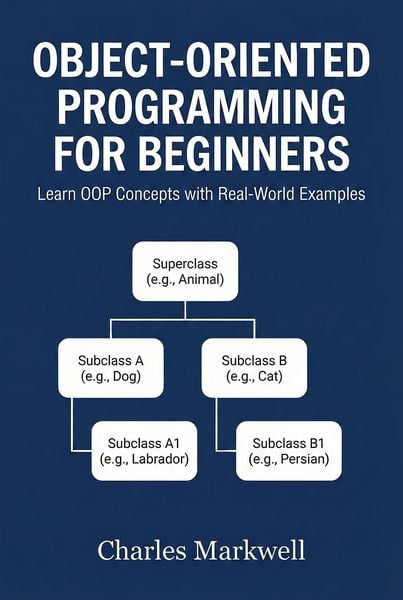
Object-Oriented Programming for Beginners: Learn OOP Concepts with Real-World Examples
-
- Einzelkauf Download ausgewählt
-
Sprache:Englisch
6,99 €
inkl. gesetzl. MwSt.Beschreibung
Produktdetails
Verkaufsrang
6948
Format
ePUB
Kopierschutz
Ja
Family Sharing
Ja
Text-to-Speech
Ja
Erscheinungsdatum
28.12.2025
Verlag
Charles MarkwellSeitenzahl
(Printausgabe)
Dateigröße
282 KB
Sprache
Englisch
EAN
9798233024528
Transition from disorganized scripting to building robust, scalable software architectures.
Many self-taught developers and computer science students encounter a significant plateau in their programming development. While you may possess a strong grasp of variables and loops, constructing complex applications often results in code that is difficult to maintain and prone to errors. Resolving a single issue can inadvertently introduce multiple new defects, leading to a cycle of inefficiency.
The solution lies not in acquiring a new programming language, but in adopting a fundamental shift in architectural thinking.
Object-Oriented Programming (OOP) serves as the industry standard for designing large-scale software systems. It facilitates the decomposition of complex problems into manageable, self-contained modules. This book acts as a comprehensive bridge, guiding you from writing linear scripts to architecting professional-grade systems.
Designed for beginners and intermediate programmers, this guide simplifies complex academic concepts, focusing on practical application. You will apply these concepts to build realistic software, including a Smart Home Device Manager and a Service Booking Platform.
What You Will Learn:
- The Four Pillars: Master Encapsulation, Abstraction, Inheritance, and Polymorphism to create flexible and maintainable codebases.
- Memory Management: Gain a deep understanding of the Stack and the Heap to eliminate bugs and optimize application performance.
- The SOLID Principles: Apply the five fundamental rules of design that distinguish amateur coding from professional software engineering.
- Design Patterns: Implement industry-standard solutions such as the Factory, Singleton, and Strategy patterns.
- Advanced Concepts: Explore composition, dependency injection, and exception handling to build fault-tolerant applications.
Why This Book Is Different:
While many programming resources rely on abstract, mathematical examples that can be difficult to contextualize, this book utilizes real-world analogies. You will model a car engine to understand encapsulation, design a zoo to understand polymorphism, and build a service marketplace to comprehend interfaces.
Although the code examples utilize a clean syntax compatible with Java and C#, the concepts presented are universal. Whether you utilize Python, C++, or JavaScript, the architectural skills acquired here will remain relevant throughout your career.
Who This Book Is For:
- Computer Science students seeking to visualize and internalize OOP concepts.
- Self-taught developers aiming to advance from junior to intermediate roles.
- Professionals desiring to write cleaner, more maintainable code.
Develop software that is not only functional but enduring.
Noch keine Bewertungen vorhanden
Verfassen Sie die erste Bewertung zu diesem Artikel
Helfen Sie anderen Kundinnen und Kunden durch Ihre Meinung.
Kurze Frage zu unserer Seite
Vielen Dank für Ihr Feedback
Wir nutzen Ihr Feedback, um unsere Produktseiten zu verbessern. Bitte haben Sie Verständnis, dass wir Ihnen keine Rückmeldung geben können. Falls Sie Kontakt mit uns aufnehmen möchten, können Sie sich aber gerne an unseren Kund*innenservice wenden.
zum Kundenservice