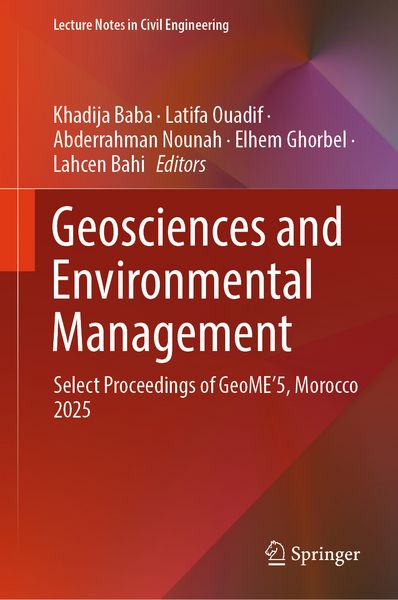
Produktbild: Geosciences and Environmental Management
Band 846 - 11%

Geosciences and Environmental Management Select Proceedings of GeoME’5, Morocco 2025

11% sparen

218,99 € UVP 246,09 €

inkl. gesetzl. MwSt., Versandkostenfrei


Beschreibung

Produktdetails

Einband

Gebundene Ausgabe

Erscheinungsdatum

08.05.2026

Abbildungen

XVII, 157 illus., 139 illus. in color., schwarz-weiss Illustrationen, farbige Illustrationen

Herausgeber

Khadija Baba + weitere

Verlag

Springer

Seitenzahl

346

Maße (L/B/H)

24,1/16/2,6 cm

Gewicht

709 g

Sprache

Englisch

ISBN

978-3-032-21799-8

Beschreibung

Produktdetails

Einband

Gebundene Ausgabe

Erscheinungsdatum

08.05.2026

Abbildungen

XVII, 157 illus., 139 illus. in color., schwarz-weiss Illustrationen, farbige Illustrationen

Herausgeber

Verlag

Springer

Seitenzahl

346

Maße (L/B/H)

24,1/16/2,6 cm

Gewicht

709 g

Sprache

Englisch

ISBN

978-3-032-21799-8

Herstelleradresse

Springer-Verlag KG
Sachsenplatz 4-6
1201 Wien
AT

Email: GPSR Kontakt

Noch keine Bewertungen vorhanden

Verfassen Sie die erste Bewertung zu diesem Artikel

Helfen Sie anderen Kundinnen und Kunden durch Ihre Meinung.

Kundinnen und Kunden meinen

Bewertungen (0)

  • Produktbild: Geosciences and Environmental Management
  • Part 1: Smart and Sustainable Materials for Civil Engineering.- Repairing method to improve the Thermal Properties of Earth Plasters using Sisal Fibers Reinforcement: Experimental Analysis and Numerical Modeling.- Mapping the Evolution of Delayed Ettringite Formation in Critical Concrete Structures: A Bibliometric Review.- Calcined Clay Grade and Reactivity Assessment Methods for Optimized Mechanical Performance in Limestone Calcined Clay Cements (LC3): A Comprehensive Review.- Impact of Recycled Fibers in Expansive Clay Foundations.- Thermal Efficiency of Compressed Earth Blocks Incorporating Apricot Nutshell Waste.- Influence of constituent dosage variation on the performance of High Modulus Asphalt (HMA).- Pozzolanic Cement's Role in Plastic Concrete optimization for Diaphragm Walls in Dams.- Comparative Life Cycle Analysis of Cement-Based and Geopolymer Concretes Incorporating Recycled Aggregates from Construction Waste.- Gum arabic and raw earth: an innovative alliance for durable, high-performance building blocks in the Drâa-Tafilalet region.- Experimental and Predictive Investigation of Eco Concrete with Settat shale for 3D printing applications.- Comparative Analysis of Alkaline and PEM Electrolyzers for Green Hydrogen Production.- Feasibility and Life Cycle Assessment of Dune Sand Based Foamed Concrete for Sustainable Construction.- Study of the physicochemical properties of earth bricks used for the restoration of the “Ksar Tabouaasamt” mosque in Errachidia, Morocco.- Hydrogen storage technologies: A comparative review.- Geopolymer-stabilized earthen materials: Toward sustainable and high-performance construction.- Experimental Investigation of the Effect of the Number of Layers on the Mechanical Performance of Jute FRP Laminates.- Optimizing Mechanical Properties of Rammed Earth in Moroccan Traditional Buildings using Recycled PET.- Part 2: Digital Technologies and Sustainable Management in Construction, Heritage, and Urban Development.- Culturally-Compatible Seismic Reinforcement for Traditional Moroccan Buildings: A Critical Review.- Feasibility Study of a Wind Farm to Power a Modular Seawater Desalination Unit.- Structural Safety Assessment of Historic Masonry Buildings using Non-destructive techniques and Emerging Technologies: A Review.- Integration of a 6D BIM-Based Thermal Simulation workflow for Green Building Design: efficiency and eco-friendly mortars composite in the Moroccan climate.- Smart urban redevelopment in the digitalisation and AI of buildings, infrastructures and territory.- Green Energy Investment and Financial Performance of Moroccan Civil Engineering Firms: An Empirical Assessment.- Enabling Smart Asset Management in the Construction Industry by coupling BIM, Digital Twins, and Artificial Intelligence.- Green Hydrogen Development in Morocco: Strategic Frameworks, Resource Assessment, and Export Potential.- The use of compressed earth blocks (CEB): an effective solution for the restoration of historical monuments.- Part 3: Artificial Intelligence and Smart Modeling for Resilient Civil Infrastructure and Environmental Systems.- Flood-resilient urban layout design via convolutional neural networks.- Crack Detection in Concrete Structures Using CNNs and Transfer Learning: A Review.- Coupled Hydromechanical Finite Element Analysis of Natural Fiber-Reinforced Expansive Soils.- Predicting Soil-Structure Interaction Using Machine Learning for Safer Infrastructure.- Mapping the Evolution of AI in Life Cycle Assessment for Buildings: A Bibliometric Review.- Machine learning-based predictive modeling for FRP reinforced concrete under fire exposure - A Review.- Exploring the applicability of artificial intelligence for predicting the environmental impact of strip mining in thick overburden areas.- Machine Learning-Based Assessment of Bridge Conditions Using Structural and Traffic Parameters.- Adaptive Rule-Based Control for Optimizing the Performance and Thermal Comfort of Multi-Fold Glazing Trombe Walls.- Machine Learning Prediction of the Substitution Rate of Conventional Sand with Marine Sediments from 15 Moroccan Ports and Their Impact on Compressive Strength: An Eco-Friendly Alternative.- Enhancing Energy Performance of a Mediterranean Greenhouse Using External Passive Shading.- Comparative Review of Seismic Analysis Methods for Rammed Earth Structures: Pushover and Time History Analysis.- Deep Learning Method for Crack Detection Using CNN Models.- Enhanced thermal performance of a tubular solar collector with cylindro-parabolic reflectors: a numerical study using ANSYS Fluent.- Comparative Analysis of Two Deep Learning Models for Crack Classification and Detection.