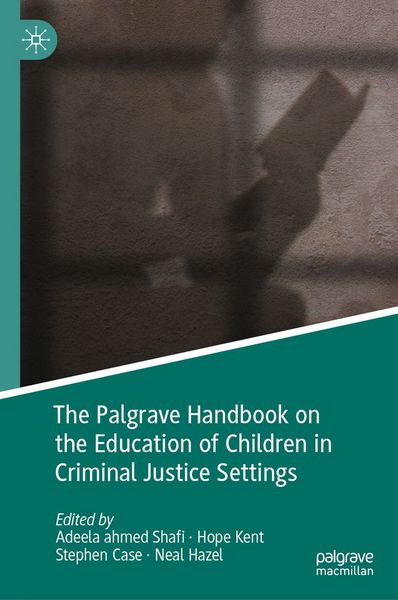
Produktbild: The Palgrave Handbook on the Education of Children in Criminal Justice Settings
Vorbesteller Neu

The Palgrave Handbook on the Education of Children in Criminal Justice Settings

187,99 €

inkl. gesetzl. MwSt., Versandkostenfrei


Beschreibung

Produktdetails

Einband

Gebundene Ausgabe

Erscheinungsdatum

30.08.2026

Herausgeber

Adeela ahmed Shafi + weitere

Verlag

Springer

Seitenzahl

660

Maße (L/B)

23,5/15,5 cm

Sprache

Englisch

ISBN

978-3-032-23119-2

Beschreibung

Portrait

Adeela ahmed Shafi is Professor of Education in Youth Justice at the University of Gloucestershire, UK. Her research is focused on the education of children and young people in secure custodial settings.

Hope Kent is a Research Fellow funded by ADR-UK at the University of Exeter, UK. Her research uses population-level data to understand the over-representation of children with neurodisability in the youth justice system.

Stephen Case is Professor of Youth Justice at Loughborough University, UK. His research and scholarship have focused on the promotion of positive, 'children first', rights-based, and anti-risk management approaches to working with children in conflict with the law.

Neal Hazel is Chair of Criminology and Criminal Justice at the University of Salford, UK. He has delivered more than 40 funded research projects, mainly in youth justice and family support.

Produktdetails

Einband

Gebundene Ausgabe

Erscheinungsdatum

30.08.2026

Herausgeber

Verlag

Springer

Seitenzahl

660

Maße (L/B)

23,5/15,5 cm

Sprache

Englisch

ISBN

978-3-032-23119-2

Herstelleradresse

Libri GmbH
Europaallee 1
36244 Bad Hersfeld
DE

Email: GPSR Kontakt

Noch keine Bewertungen vorhanden

Verfassen Sie die erste Bewertung zu diesem Artikel

Helfen Sie anderen Kundinnen und Kunden durch Ihre Meinung.

Kundinnen und Kunden meinen

Bewertungen (0)

Weitere Artikel finden Sie in

  • Produktbild: The Palgrave Handbook on the Education of Children in Criminal Justice Settings
  • Chapter 1: Introduction: Aims, Purposes, and Contributions of the Handbook.- Part 1: The Issues.- Chapter 2: The Key Debate: The Child vs. The Offender.- Chapter 3: Historical and Cross-Cultural Concepts of Childhood and Justice.- Chapter 4: Children's Education in Prison: Social Ecological Perspectives.- Chapter 5: Over-Representation of Black or Minority Ethnic Groups in the American Juvenile Justice System and Possible Connections to Educational Opportunities.- Chapter 6: Missing Links in the Abu Dhabi Juvenile Correctional System: Advocacy for Educational Equity.- Chapter 7: Minding the Gap : Young People's Education Transitions from Custody to the Community.- Chapter 8: Juvenile in Detention and the Right to Education in Pakistan.- Chapter 9: Prison Education in Norway for Young Prisoners: The Import Model.- Part 2: Who are the Children that are Incarcerated?- Chapter 10: I Hated School, But LovedEducation.- Chapter 11: "A Day in the Life".- Chapter 12: Neurodisability/Neurodiversity: The New Kid on the Block.- Chapter 13: America's Prison Kids: Who Are They?- Chapter 14: Girls, Education, and Youth Justice.- Part 3: What's Working Well in Education and Where?- Chapter 15: Child First Education in Custody.- Chapter 16: Education as an Integrated Approach and a Preventative Tool for Young People in Conflict with the Law in the Spanish Context.- Chapter 17: Children with Special Educational Needs and Disabilities are Children Too! Looking at 'Child First' as an Equaliser in School Education.- Chapter 18: Global South Youth Education: Moving from the Pedagogy of the Oppressed to the Pedagogy of Hope in Educational Communities in Brazil.- Chapter 19: How Peer Mentoring Can Transform Youth Justice Services.- Chapter 20: Education and Change in the Greek Correctional System.- Chapter 21: Promoting Trauma-Informed Teaching and Learning for Incarcerated Youth through an Action Research Model in New Jersey, USA.- Chapter 22: Restorative Approaches.- Chapter 23: Italian Juvenile Justice Services: Pathways and Opportunities for the Growth of Juveniles and Young Adult Offenders.- Chapter 24: Education of Children Convicts and Detainees in Turkey.- Chapter 25: Technology Innovation in the Children and Young People's Secure Estate.- Chapter 26: Fostering Empathy through Education: Promoting Socio-Emotional Understanding and Wellbeing in Youth Detention in Australasia.- Chapter 27: Conclusion: What Can We Learn By Taking a Global Perspective.