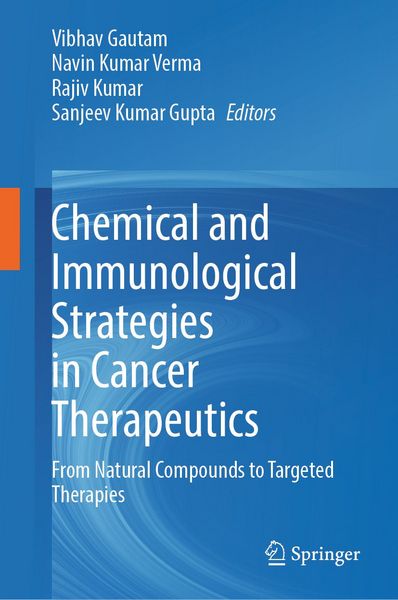
Produktbild: Chemical and Immunological Strategies in Cancer Therapeutics

Chemical and Immunological Strategies in Cancer Therapeutics From Natural Compounds to Targeted Therapies

169,99 €

inkl. gesetzl. MwSt., Versandkostenfrei


Beschreibung

Produktdetails

Einband

Gebundene Ausgabe

Erscheinungsdatum

05.07.2026

Abbildungen

XXIV, 422 p. 40 illus., 17 illus. in color.

Herausgeber

Vibhav Gautam + weitere

Verlag

Springer Singapore

Seitenzahl

422

Maße (L/B/H)

24,1/16/3 cm

Gewicht

832 g

Auflage

1. Auflage

Sprache

Englisch

ISBN

978-981-9597-76-5

Beschreibung

Portrait


Dr. Vibhav Gautam integrates ethnopharmacology, nanobiotechnology, and omics sciences to develop targeted cancer therapeutics, with a primary focus on breast and urinary bladder cancers. His research has led to the identification of bioactive compounds from fungal endophytes that demonstrate apoptosis-inducing activity in breast cancer models. He has also developed nanomedicine-based drug delivery systems to improve therapeutic efficacy while reducing systemic toxicity. In addition, his omics-driven studies have contributed to the identification of novel biomarkers and the advancement of personalized cancer therapy.


Dr. Navin Kumar Verma completed his PhD and postdoctoral training in Clinical Medicine at Trinity College Dublin, Ireland. He is currently an Associate Professor of Immunology and Cell Biology at Lee Kong Chian School of Medicine, Nanyang Technological University, Singapore. His research focuses on T-cell immunology in wound healing and cancer. Dr. Verma has published over 100 peer-reviewed articles, holds multiple patents, and has received several national and international awards. He is an elected Fellow of the Royal Society of Biology, UK.


Dr. Rajiv Kumar received his Master’s and PhD degrees in Biochemistry from Banaras Hindu University and completed postdoctoral training at QIMR Berghofer Medical Research Institute, Australia. His research focuses on cellular and molecular immunology of parasitic diseases, diagnostics, and therapeutic development. He is a member of the National Academy of Sciences, India, and the National Academy of Medical Sciences, India. Dr. Kumar has received several prestigious awards and has published extensively in high-impact international journals in immunology and translational medicine.


Prof. Sanjeev Kumar Gupta is a distinguished surgeon and academician with extensive national and international recognition. He has received several prestigious fellowships, including the Commonwealth Fellowship, Boyscast Fellowship, UICC Fellowship, and Fellowships of the Royal College of Surgeons of Edinburgh and the National Academy of Medical Sciences, India. He has delivered numerous renowned orations and received multiple awards for excellence in surgical education and research. His academic achievements include gold medals and distinctions in medical education and significant contributions to surgical oncology.

Produktdetails

Einband

Gebundene Ausgabe

Erscheinungsdatum

05.07.2026

Abbildungen

XXIV, 422 p. 40 illus., 17 illus. in color.

Herausgeber

Verlag

Springer Singapore

Seitenzahl

422

Maße (L/B/H)

24,1/16/3 cm

Gewicht

832 g

Auflage

1. Auflage

Sprache

Englisch

ISBN

978-981-9597-76-5

Herstelleradresse

Springer-Verlag KG
Sachsenplatz 4-6
1201 Wien
AT

Email: GPSR Kontakt

Noch keine Bewertungen vorhanden

Verfassen Sie die erste Bewertung zu diesem Artikel

Helfen Sie anderen Kundinnen und Kunden durch Ihre Meinung.

Kundinnen und Kunden meinen

Bewertungen (0)

  • Produktbild: Chemical and Immunological Strategies in Cancer Therapeutics

  • 1. Exploring the chemical foundations of cancer therapeutics and their historical evolution.- 2. Unveiling the structural diversity and bioactivity of natural compounds in oncology.- 3. Chemistry of plant-derived compounds like curcumin and their role in anticancer mechanisms.- 4. Distinct Chemical Scaffolds of Marine-Derived Compounds and Their Translational Potential in Targeted Cancer Therapy.- 5. Exploring the Chemical and Therapeutic Potential of Fungal Secondary Metabolites for Targeted Cancer Therapy.- 6. Chemical Approaches for Developing Potent Kinase Inhibitors and DNA-Targeting Agents in Cancer Therapy.- 7. Exploring the chemistry of platinum, ruthenium, and gold complexes in oncology.- 8. Development of Nanocarriers, Including Liposomes, Dendrimers, and Polymeric Nanoparticles, for Targeted Cancer Therapy.- 9. Enhancing the Therapeutic Efficacy of Anticancer Agents through Strategic Chemical Modification and Targeted Conjugation.- 10. Immune check point molecules and host directed therapy for cancer.- 11. Utilizing Molecular Modeling, Docking Studies, and Structure-Activity Relationship (SAR) Analysis for Optimizing Anticancer Drug Design.- 12. Techniques for synthesizing and evaluating libraries of potential anticancer agents.- 13. Advancing Targeted Cancer Therapy through AI-Driven Drug Design and CRISPR-Based Precision Targeting.- 14. Sustainable and eco-friendly approaches to drug synthesis and development.- 15. Development of Chemical Inhibitors Targeting Epigenetic Enzymes like Histone Deacetylases, DNMTs, and Bromodomains for Cancer Therapy.- 16. Small molecules inhibitors and combination therapy for cancer.- 17. Designing Metal Complexes for Cancer Targeting: Challenges and Strategies.