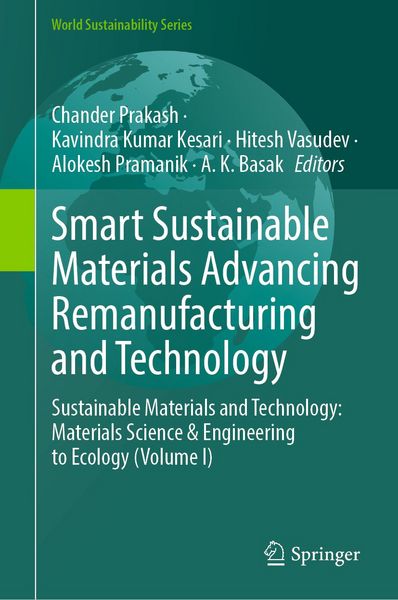
Produktbild: Smart Sustainable Materials Advancing Remanufacturing and Technology

Smart Sustainable Materials Advancing Remanufacturing and Technology Sustainable Materials and Technology: Materials Science & Engineering to Ecology (Volume I)

156,99 €

inkl. gesetzl. MwSt., Versandkostenfrei


Beschreibung

Produktdetails

Einband

Gebundene Ausgabe

Erscheinungsdatum

12.07.2026

Abbildungen

IX, 632 p. 135 illus., 126 illus. in color.

Herausgeber

Chander Prakash + weitere

Verlag

Springer

Seitenzahl

632

Maße (L/B/H)

24,1/16/4 cm

Gewicht

1119 g

Sprache

Englisch

ISBN

978-3-032-26149-6

Beschreibung

Portrait

Prof. Chander Prakash is working as Professor at the School of Engineering and Pro-Vice Chancellor, research, ranking, and accreditation at Geeta University, Haryana, India. He is also associated as Project Head at the Research Laboratory of 3D Bioprinting Technologies for Flexible Electronics, Institute of Nanotechnology, Electronic and Equipment Engineering, Southern Federal University, Taganrog, Russia. He is a passionate researcher with diversified research interests—developing materials for biomedical and healthcare applications, additive manufacturing, and developing and exploring new cost-effective manufacturing technologies for biomedical industries. To date, he has published more than 585 scientific articles in various peer-reviewed, reputed top-notch journals, conferences, and books in Materials Science and Manufacturing. He is a Highly Cited Researcher at the international level, and he has 18600 citations, an H-index of 75, and an i-10 index is 318 (as of January 2026). He edited/authored 40 books, serving as Series Editor of 3 books, Editorial Board Member of journals. He holds the 38th rank in India and 1,590th rank in the world. He also consistently appeared in the top 2% of researchers as per the Stanford Study in 2021, 2022, 2023, and 2024.

Dr. Kavindra Kesari is a Researcher, Aalto University, Espoo, Finland. Previously, he worked as a Postdoctoral Researcher at the University of Helsinki, and University of Eastern Finland, Kuopio, Finland (since 2013). He also served as an Associate Professor at Lovely Professional University, Punjab and a Full Professor at Chandigarh University, Punjab in recent years. He is actively involved in material-based research on biomaterials, hybrid materials and cancer research. He has published over 150 papers (H-index 58: Google Scholar as of June 2026) in reputed scientific journals, 30 book chapters, and 9 books, and has presented over 50 papers at national and international scientific meetings. He is listed in the Top 2% world’s leading scientists published by Stanford University and Elsevier. Also acting as a visiting fellow for INTI International University, Malaysia and Adjunct Professor for Chandigarh University, Mohali, India. He received four times Young Scientist Award for his outstanding contribution to research.

Hitesh Vasudev is working as a professor in the Department of Mechanical Engineering, Lovely Professional University (LPU), Phagwara, Punjab, India. He has received his Ph.D. degree from Guru Nanak Dev Engineering College, Ludhiana, India. His research areas include surface engineering/thermal spraying. He is currently working on the development of nanostructured materials and hybrid materials. He has won the Research Excellence Award for three consecutive years (2019, 2020, and 2021) at LPU. He has published over 100 indexed papers, 15 conference papers, 4 books, and 25 book chapters. He also consistently appeared in the top 2% of researchers as per Stanford Study in 2023.

Dr. Alokesh Pramanik is currently a senior lecturer in Mechanical Engineering, School of Civil and Mechanical Engineering at Curtin University, Australia. His area of research is synthesis/development, surface modification, and advanced/precision machining of metallic and non-metallic biomaterials. Synthesis and development of magnesium-based biodegradable and titanium-based alloys and composites, respectively, using innovative manufacturing techniques such as spark plasma sintering, electrospinning, and 3D printing. He has published over 150 research articles in the peer-reviewed international journals, conference proceedings, and book chapters. His h-index of 44, i-10 index of 117, and total citations of 6851 strongly endorse his high research productivity. He has published 10 books with Springer and CRC Press—Taylor & Francis Group and 10 edited books are under progress. He has authored one book. He is also acting as a guest editor of 5 international peer-reviewed journals.

Dr. Basak graduated in 2002 with a B.Sc. in Metallurgical Engineering degree from Bangladesh University of Engineering and Technology (BUET), Dhaka, Bangladesh, with honors. Upon the completion of master’s and Ph.D. degrees in Materials Science and Engineering from Katholieke Universiteit Leuven (KULeuven), Belgium, he started working in different Australian universities. His research interests include nanostructured materials, high-resolution electron microscopy and probe analysis, nanoscale fabrication of materials, deformation mechanisms of novel materials, nanomechanics, tribology and tribocorrosion, electrochemistry and electrochemical measurement techniques. He has published more than 50 research articles which are well cited in this area.

Produktdetails

Einband

Gebundene Ausgabe

Erscheinungsdatum

12.07.2026

Abbildungen

IX, 632 p. 135 illus., 126 illus. in color.

Herausgeber

Verlag

Springer

Seitenzahl

632

Maße (L/B/H)

24,1/16/4 cm

Gewicht

1119 g

Sprache

Englisch

ISBN

978-3-032-26149-6

Herstelleradresse

Springer-Verlag KG
Sachsenplatz 4-6
1201 Wien
AT

Email: ProductSafety@springernature.com

Noch keine Bewertungen vorhanden

Verfassen Sie die erste Bewertung zu diesem Artikel

Helfen Sie anderen Kundinnen und Kunden durch Ihre Meinung.

Kundinnen und Kunden meinen

Bewertungen (0)

  • Produktbild: Smart Sustainable Materials Advancing Remanufacturing and Technology
  • Introduction.- Historical perspectives of SMART materials.- Implementing technology for remanufacturing, recycling, and recovery.- Optimizing process technologies for transforming scrap into reusable raw materials.- Eco-friendly machining.- Technology development for SMART production.- Use of Artificial intelligence, sensors, and robots shaping SMART materials.- In-depth understanding of the benefits–and costs–of using renewable materials.- Concluding remarks and Futuristic approach.