Gutscheinbedingungen

Gültig bis 13.07.2026 | Gültig für Spielzeug (außer Tonieboxen & ausgewählte Tonies), Filme, Musik, Software, Games, Schreibwaren, Hörbücher und Hörbuch-Downloads (außer Abo & Shelfies), gebrauchte Bücher, nicht preisgebundene Bücher und Kalender | Einlösbar unter osiander.de und in der Osiander App | Click & Collect nur mit Online-Zahlung (Paypal/Kreditkarte) vorab | Einzelne Artikel können ausgeschlossen sein | Nicht kombinierbar mit anderen Gutscheinen oder Preisaktionen | Nur einmal pro Einkauf einlösbar | Gutschein wird auf max. 500€ Bestellwert angerechnet | Keine Barauszahlung | Digitale Hörbücher nur für Android | Nicht gültig für preisgebundene Artikel (aufgrund der Buchpreisbindung sind Gutscheine nicht auf Bücher, eBooks, Presse einlösbar), tolino eReader & Zubehör, Elektronik, Geschenke & Trends, Abonnements & Flatrates, Geschenkkarten, Versandkosten und Services

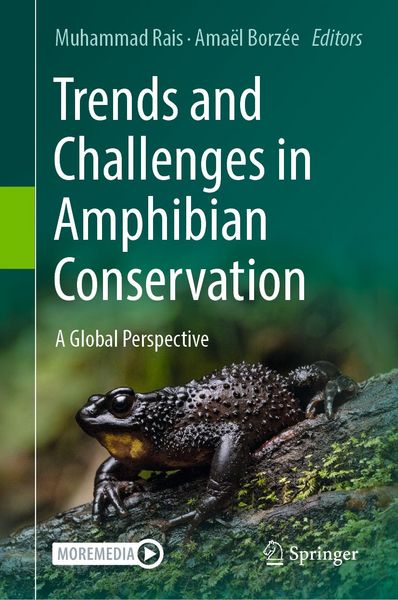
Produktbild: Trends and Challenges in Amphibian Conservation
Neu

Trends and Challenges in Amphibian Conservation A Global Perspective

241,99 €

inkl. gesetzl. MwSt., Versandkostenfrei


Beschreibung

Produktdetails

Einband

Gebundene Ausgabe

Erscheinungsdatum

15.08.2026

Abbildungen

Approx. 30 illus., schwarz-weiss Illustrationen

Herausgeber

Muhammad Rais + weitere

Verlag

Springer

Seitenzahl

649

Maße (L/B)

23,5/15,5 cm

Sprache

Englisch

ISBN

978-3-032-26425-1

Beschreibung

Portrait

Muhammad Rais is leading the Herpetology Lab at Department of Zoology, Wildlife and Fisheries, PMAS-AAUR. His laboratory works on abundance estimation, occupancy analysis, species distribution modelling, morphometric analysis, diet analysis, population monitoring using conventional and eDNA techniques, space and habitat use and molecular ecology. He is a member of IUCN Amphibian Specialist Group, Species Conservation and Planning Group, Species Survival Commission, Commission on Ecosystem Management and Global Ecosystem-based Adaptation Fund Expert Group. He has won Gold Medals for standing first in MSc Zoology (Wildlife and Fisheries) examination (2004), Dr. Abdul Aleem Chaudhary Gold Medal (2019) for his contribution in Wildlife Management, Future Leaders in Amphibian Conservation (2020) for his contribution in Amphibian Ecology and Conservation, Professional Development Opportunity for Pakistan Award (2020) by the Government of Australia and Research Award (2023) by Arid Agriculture University Rawalpindi.

Amaël Borzée  is a Professor of behavioural ecology and conservation at Nanjing Forestry University, where he leads the Laboratory of Animal Behaviour and Conservation. His personal focus is on conservation in Northeast Asia, with a special interest in treefrogs. His laboratory focuses on species conservation in Asia, drawing on all research perspectives required for effective conservation practices.

He considers collaboration a crucial factor in successful conservation research and action, and he actively works with local communities, policymakers, and conservation organizations to promote amphibian awareness and conservation. Together with these partners, he develops strategies to protect species and habitats and to mitigate the impacts of human activities.

Beyond his scientific work, he promotes and actively contributes to citizen science as a valuable tool for education and conservation. He serves as co-chair of the IUCN SSC Amphibian Specialist Group, helping to advance amphibian conservation on a global scale.

Produktdetails

Einband

Gebundene Ausgabe

Erscheinungsdatum

15.08.2026

Abbildungen

Approx. 30 illus., schwarz-weiss Illustrationen

Herausgeber

Verlag

Springer

Seitenzahl

649

Maße (L/B)

23,5/15,5 cm

Sprache

Englisch

ISBN

978-3-032-26425-1

Herstelleradresse

Springer Nature Customer Service Center GmbH
Europaplatz 3
69115 Heidelberg
DE
ProductSafety@springernature.com

Noch keine Bewertungen vorhanden

Verfassen Sie die erste Bewertung zu diesem Artikel

Helfen Sie anderen Kundinnen und Kunden durch Ihre Meinung.

Kundinnen und Kunden meinen

Bewertungen (0)

  • Produktbild: Trends and Challenges in Amphibian Conservation
  • Conserving Madagascar’s Endemic Amphibians: Past Lessons and Future Priorities.- Conservation Assessment of Atlantic Forest Montane Direct-Developing Anurans.- The Amphibian Fauna of Sri Lanka: Past, Present, and Future with Conservation Implications.- Amphibian Conservation Guiding Tools: Assessment and Planification as the First Steps.- Amphibian Conservation in Africa: Trends and Challenges.- Biological Invasions and Their Impact on Native Amphibian Species.- Amphibian Ecological Restoration.- Facing the Giant: The Goliath Frog and Its Battle Against Habitat Loss.- Can Urbanized Habitats Play a Role in the Conservation of Arabian and Dhofar Toads in the United Arab Emirates?.- The Dual Threat of Ranavirus and Chytrid Fungus.- Assessing the Impacts of Global Climate Change on Threatened Amphibians.- Ecotoxicological Impacts of Nematicides and Fungicides on Amphibians.- Understanding the Effect of Topography on Amphibian Species Distribution, Eastern Himalayas, India.- Status and Challenges of Acoustic Monitoring on Anuran Biodiversity.- Exploring the Tech Frontier for Amphibian Monitoring: Bridging the Gap Between Research and Conservation Actions.- Amplifying Amphibian Conservation Efforts through Passive Acoustic Monitoring in Southeast Asia.- How Ex Situ Populations of Amphibians Can Help Address Critical Knowledge Gaps.- Application of Reproductive Technologies and Biobanking for Global Amphibian Conservation.- Adaptive Post-release Monitoring for Amphibian Reintroductions and Other Conservation Translocations.- The Response of the Ex Situ Community to the Amphibian Crisis: The Role of Zoos, Aquariums, and Other Organizations in Amphibian Conservation.- Evidence-based Amphibian Conservation in South Africa: Improvements through Integrative Conservation Legislation, Collaboration, and Research.- Community-based Conservation of the Jambato Harlequin Toad (Atelopus ignescens) in the Ecuadorian Andes: Challenges and Milestones.- Scaling Up Amphibian Conservation through Collaborative and Coordinated Multi-institutional Regional Efforts and Community Engagement.