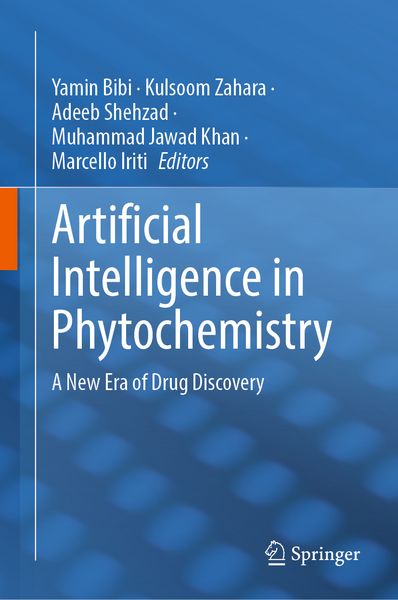
Produktbild: Artificial Intelligence in Phytochemistry
Vorbesteller Neu

Artificial Intelligence in Phytochemistry A New Era of Drug Discovery

169,99 €

inkl. gesetzl. MwSt., Versandkostenfrei


Beschreibung

Produktdetails

Einband

Gebundene Ausgabe

Erscheinungsdatum

11.07.2026

Abbildungen

XXIV, 38 illus., 32 illus. in color., farbige Illustrationen, schwarz-weiss Illustrationen

Herausgeber

Yamin Bibi + weitere

Verlag

Springer Singapore

Seitenzahl

261

Maße (L/B)

23,5/15,5 cm

Sprache

Englisch

ISBN

978-981-9208-74-6

Beschreibung

Portrait

Dr. Yamin Bibi is Chairperson of the Department of Botany at Rawalpindi Women University, Pakistan. Her research focuses on plant-based natural products, particularly the isolation and characterization of bioactive compounds and their pharmacological evaluation. She has supervised numerous PhD and MPhil students, completed funded projects, and published widely in national and international journals. Recipient of multiple research awards, she brings her expertise in natural product chemistry and leadership as Corresponding Editor to highlight how artificial intelligence can accelerate discovery of plant-derived therapeutics. 

Dr. Kulsoom Zahara is an emerging scholar in phytochemistry and pharmacognosy, she specializes in isolating and identifying bioactive compounds using advanced techniques such as HPLC-DAD and GC-MS. Her research explores anticancer and antimicrobial properties of diverse plants, with growing emphasis on in silico and AI-driven approaches to predict bioactivity and safety. She contributes expertise in plant-based drug discovery and food safety, underscoring the transformative role of AI in modern phytochemical research. 

Dr. Adeeb Shehzad is Associate Professor at the Biodiversity Research Center, Dhofar University, Oman. A globally recognized biomedical scientist, his pioneering work spans molecular biology, nanomedicine, and translational therapeutics. With advanced degrees from Kyungpook National University, South Korea, and prior appointments in Pakistan and Saudi Arabia, he has published over 100 papers with an h-index of 34. His research on cell signaling, nanomaterials, and regenerative medicine bridges fundamental science with clinical innovation. Listed among the World’s Top 2% Scientists, he continues to advance biomedical education and sustainable health innovation. 

Dr. Muhammad Jawad Khan is Associate Professor at Prince Sattam Bin Abdul Aziz University, Saudi Arabia. He specializes in artificial intelligence, disease modeling, and biomedical diagnostics, with a focus on neurological disorders. Holding a PhD in Mechanical Engineering from Pusan National University, South Korea, he has advanced hybrid EEG-fNIRS systems for neuro-robotics and medical diagnostics. His interdisciplinary work spans AI-driven modeling, robotics, and prosthetic limb design. Recognized among the World’s Top 2% Researchers (Stanford, 2022), he has secured major research funding and led award-winning projects such as the iMeche UAS Challenge 2022. 

Dr. Marcello Iriti is Professor of Plant Biology and Pathology at the University of Milan, Italy. His research covers phytochemistry, pharmacology, nutraceuticals, and functional foods, with emphasis on plant secondary metabolites and the Mediterranean diet. Author of over 230 publications, he has advanced understanding of antioxidants, essential oils, and phytotherapeutics in preclinical and clinical contexts. He serves on editorial boards, is a member of the World Academy of Sciences, Asian Council of Science Editors, and Italian Pharmacological Society, and is a founding member of the Italian Society of Environmental Medicine. A dedicated mentor, he exemplifies integration of traditional phytochemistry with modern biomedical sciences. 

Produktdetails

Einband

Gebundene Ausgabe

Erscheinungsdatum

11.07.2026

Abbildungen

XXIV, 38 illus., 32 illus. in color., farbige Illustrationen, schwarz-weiss Illustrationen

Herausgeber

Verlag

Springer Singapore

Seitenzahl

261

Maße (L/B)

23,5/15,5 cm

Sprache

Englisch

ISBN

978-981-9208-74-6

Herstelleradresse

Springer Nature Customer Service Center GmbH
Europaplatz 3
69115 Heidelberg
DE
ProductSafety@springernature.com

Kundinnen und Kunden meinen

0 Bewertungen

Informationen zu Bewertungen

Zur Abgabe einer Bewertung ist eine Anmeldung im Konto notwendig. Die Authentizität der Bewertungen wird von uns nicht überprüft. Wir behalten uns vor, Bewertungstexte, die unseren Richtlinien widersprechen, entsprechend zu kürzen oder zu löschen.

Die Bewertungen sind nach Format, Anzahl Sterne und Datum sortiert.

Verfassen Sie die erste Bewertung zu diesem Artikel

Helfen Sie anderen Kund*innen durch Ihre Meinung

Kundinnen und Kunden meinen

0 Bewertungen filtern

  • Produktbild: Artificial Intelligence in Phytochemistry
  • Part I. Phytochemistry and drug discovery.- Chapter 1. Foundation of Phytochemistry and AI-Driven Innovations in Drug Discovery.- Part II. AI Simulation Techniques in phytochemistry.- Chapter 2. AI-Powered Prediction of Molecular Properties of Phytochemicals.- Chapter 3. Simulation of Drug-Phytochemical Interactions Using Artificial Intelligence (AI).- Chapter 4. AI-Driven Optimization of Phytochemical Drug Candidates.- Part III. Pharmacological Applications of AI in phytopharmacology.- Chapter 5. AI Tools for Designing Phytopharmacological Agents.- Chapter 6. Predicting Efficacy And Toxicity Of Phytochemical Drugs With Ai Models.- Chapter 7. Case Studies: AI in preclinical and Clinical phytopharmacology.- Part IV. Integration of AI in phytopharmacological Research.- Chapter 8. AI Techniques in the Discovery of Novel Phytochemical Compounds.- Chapter 9. AI-Assisted Development of Personalized phytopharmacological Therapies.- Chapter 10. Collaborative Strategies For Pharma Companies Using Ai In Phytopharmacology.- Part V. Challenges of artificial intelligence in the phytochemistry and drug discovery.- Chapter 11. Ethical Concerns in Leveraging AI for Phytochemistry.- Chapter 12. Legal and Regulatory Implications of AI Utilization in Drug Development. Chapter 13. Managing Security Risks in AI Deployment.- Chapter 14. Strategic Solutions for Overcoming Challenges in AI Adoption.