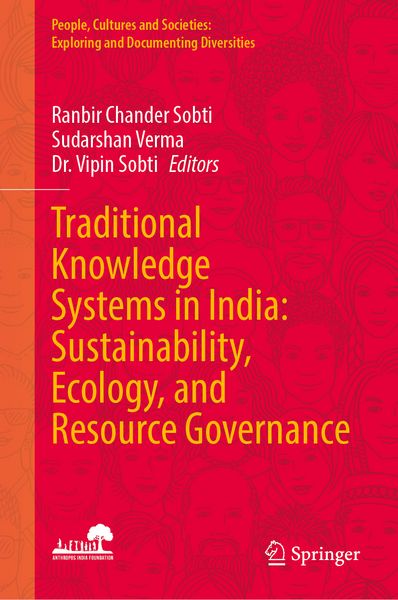
Produktbild: Traditional Knowledge Systems in India: Sustainability, Ecology, and Resource Governance
Neu

Traditional Knowledge Systems in India: Sustainability, Ecology, and Resource Governance

136,99 €

inkl. gesetzl. MwSt., Versandkostenfrei


Beschreibung

Produktdetails

Einband

Gebundene Ausgabe

Erscheinungsdatum

23.07.2026

Abbildungen

XVI, 368 p. 55 illus., 41 illus. in color.

Herausgeber

Ranbir Chander Sobti + weitere

Verlag

Springer Singapore

Seitenzahl

368

Maße (L/B/H)

24,1/16/2,7 cm

Gewicht

738 g

Sprache

Englisch

ISBN

978-981-9213-45-0

Beschreibung

Portrait

Ranbir Chander Sobti is Honorary Scientist, Indian National Science Academy (INSA) and Emeritus Professor  Panjab University Chandigarh. He is former Vice Chancellor Of Panjab University, Chandigarh and Babasaheb Bhimrao Ambedkar University, Lucknow. He has also served as Education Consultant to the Governor of Bihar and as Senior Scientist INSA. His career spans academic leadership, scientific research, and higher education administration.

Sudarshan Verma is Head Department of Law, Babasaheb Bhimrao Ambedkar Central University Lucknow is an educationist ,have  edited eight  books and published more than 40 articles in reputed journals and books.

Vipin Sobti is an educationist with over four decades of teaching experience in psychology and child development at undergraduate and postgraduate levels. A former Principal of Government College, Mohali, Punjab, she later served as a member of the Education Tribuna Punjab. She has published a number of books and articles and has delivered talks at national and international conferences. 

Produktdetails

Einband

Gebundene Ausgabe

Erscheinungsdatum

23.07.2026

Abbildungen

XVI, 368 p. 55 illus., 41 illus. in color.

Herausgeber

Verlag

Springer Singapore

Seitenzahl

368

Maße (L/B/H)

24,1/16/2,7 cm

Gewicht

738 g

Sprache

Englisch

ISBN

978-981-9213-45-0

Herstelleradresse

Libri GmbH
Europaallee 1
36244 Bad Hersfeld
DE

Email: GPSR Kontakt

Noch keine Bewertungen vorhanden

Verfassen Sie die erste Bewertung zu diesem Artikel

Helfen Sie anderen Kundinnen und Kunden durch Ihre Meinung.

Kundinnen und Kunden meinen

Bewertungen (0)

  • Produktbild: Traditional Knowledge Systems in India: Sustainability, Ecology, and Resource Governance
  • Part I – Tribal Indigenous Knowledge and Environmental Sustainability: Chapter 1: Indigenous Knowledge and Community Centric Natural Resources Management in Nepal.- Chapter 2: Ethnobotanical Wisdom of Tribal Communities.- Chapter 3: Ethno-Botany and Ethno-Pharmacology of Indravaruni: An Important Medicinal Plant of Tribal Culture and Its Action Against Sars-Cov-2.- Chapter 4: Role of Bodies for the Conservation of Bio-diversity under Bio-diversity Act, 2002.- Chapter 5: Harnessing Indigenous Water Resources: Integrating Traditional Water Harvesting Systems with Modern Practices in India.- Chapter 6: Indigenous Water Management and Environmental Sustainability in Himalayas.- Chapter 7: Traditional wisdom and forest management in Myanmar.- Chapter 8: Role of Beliefs and Practices in Natural Resource Management: Insights from Gaddi Tribe, Himachal Pradesh.- Chapter 9: Sacred Journeys and Tribal Wisdom: Integrating Traditional Practices and Modern Technologies During the Amarnath Yatra.- Chapter 10: Rooted Resilience: Indigenous Agricultural Practices and Traditional Farming Wisdom Among India’s Tribal Communities.- Chapter 11: Harmony of Heights: Harnessing Himalayan Indigenous Knowledge for Sustainable Pastoralism.- Chapter 12: Preserving Tribal Wisdom: Integrating Western Himalayan Tribal Knowledge for Accelerating Sustainable Development Goals.- Part II – Tribal Indigenous Knowledge – Food Security and Health: Indigenous Fermented Foods of the Ethnic Meitei’s of Manipur and Its Nutritional Benefits.- Chapter 13: Indigenous Fermented Foods of the Ethnic Meitei’s of Manipur and Its Nutritional Benefits.- Chapter 14: Fermenting Heritage: The Traditional Alcoholic Beverages of Kinnaura Tribes in Kinnaur, Himachal Pradesh.- Chapter 15: The Tribals and Rural Population of India: Food and Livelihood Security.- Chapter 16: Food Security through Indigenous Agricultural Practices: A case study of birbhum district, West Bengal, India.- Chapter 17: Traditional Healing Practices: A Study Among the Western Himalayan Gaddi Tribe.- Chapter 18: The Therapeutic Influence of Yoga on Well-being and Happiness.- Chapter 19: An Ethnographic Study on the Rongmei Naga Tribes of Manipur: Change and Continuity.- Chapter 20: Indigenous Medical Wisdom: A case study of Rung Community of Kumaun Himalayas.