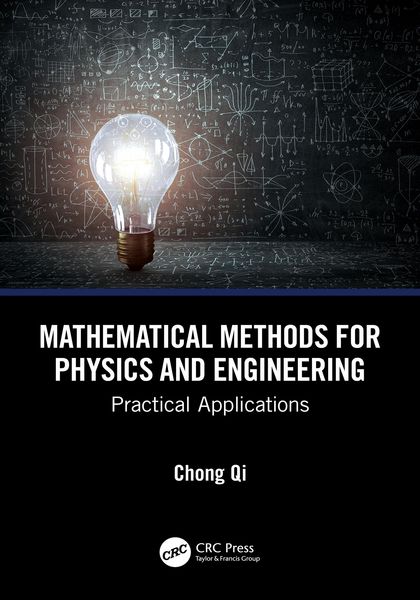
Mathematical Methods for Physics and Engineering Practical Applications
-
- Hardcover
- Taschenbuch
- eBook ausgewählt
-
Form:Einzelkauf Download
-
Sprache:Englisch
70,99 €
inkl. gesetzl. MwSt.Artikel erhalten
Beschreibung
Produktdetails
Format
Kopierschutz
Nein
Family Sharing
Nein
Text-to-Speech
Nein
Erscheinungsdatum
15.07.2026
Verlag
Taylor & Francis eBooksSeitenzahl
270 (Printausgabe)
Dateigröße
14533 KB
Auflage
1. Auflage
Sprache
Englisch
EAN
9781040551851
This book provides an accessible introduction to mathematical methods essential for physics, engineering, and modern computational analysis. Starting from foundational topics such as ordinary and partial differential equations, readers are then introduced to powerful techniques including Fourier and Laplace transforms, series expansions, matrix and eigenvalue methods, and numerical strategies such as iterative refinement.
"Mathematical Methods for Physics and Engineering: Practical Applications" emphasizes intuitive understanding and real-world applications: why the Lagrangian in classical mechanics takes the form T-V; how stability and sensitivity analysis connect to condition numbers and perturbation theory; and how matrix representations provide insight into optimisation and numerical stability.
Numerical examples and step-by-step derivations encourage active problem-solving and demonstrate how abstract methods translate into practical computations. It also highlights how these mathematical tools form the foundation of many techniques used in contemporary machine learning; from optimization algorithms and least-squares regression to spectral methods, kernel functions, and high-dimensional data analysis.
This is an ideal textbook for advanced undergraduate and graduate students studying mathematical methods for physics and/or engineering. Readers are equipped not only a versatile toolkit of methods, but also a deeper conceptual understanding of when, where, and why each tool is appropriate - empowering them to approach problems in physics and engineering.
Key features:
- Provides a toolkit of mathematical methods
- Pedagogically focused, with homework problems included with each chapter
- Covers exciting topics including high-dimensional data analysis and machine learning
Chong Qi is an Associate Professor in the Division of Nuclear Science and Engineering, Department of Physics, at the KTH Royal Institute of Technology, Stockholm. His research spans theoretical nuclear physics, many-body physics, and computational physics. He teaches courses in mathematical physics, subatomic and nuclear physics, and quantum many-body theory, and supervises students at both undergraduate and graduate levels in nuclear physics and nuclear engineering. He earned his PhD from Peking University, followed by postdoctoral research at KTH, and has since held visiting professorships at several universities around the world, including Sun Yat-sen University, where a large part of this book was written. He also serves in various editorial roles and is an honorary member of the Romanian Academy of Scientists.
Kundinnen und Kunden meinen
Verfassen Sie die erste Bewertung zu diesem Artikel
Helfen Sie anderen Kund*innen durch Ihre Meinung
Kurze Frage zu unserer Seite
Vielen Dank für Ihr Feedback
Wir nutzen Ihr Feedback, um unsere Produktseiten zu verbessern. Bitte haben Sie Verständnis, dass wir Ihnen keine Rückmeldung geben können. Falls Sie Kontakt mit uns aufnehmen möchten, können Sie sich aber gerne an unseren Kund*innenservice wenden.
zum Kundenservice