Beschreibung
Produktdetails
Format
ePUB
Kopierschutz
Ja
Family Sharing
Ja
Text-to-Speech
Ja
Erscheinungsdatum
03.05.2026
Verlag
Ritesh ModiSeitenzahl
(Printausgabe)
Dateigröße
421 KB
Sprache
Englisch
EAN
9798235620957
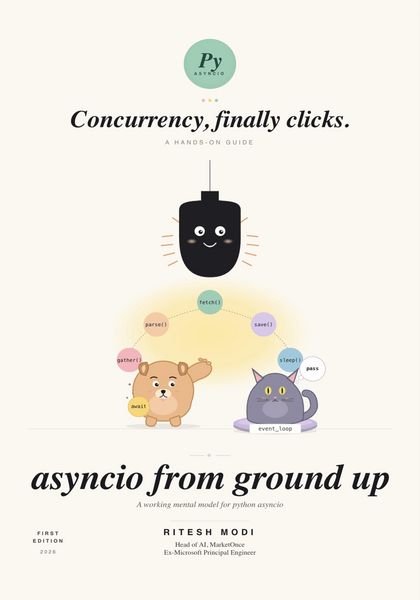
You have probably tried asyncio once and given up. You may have searched "python asyncio tutorial" and bounced off three of them. You may have copied an async def from somewhere without understanding why. You may have closed a code review the moment await appeared on the screen. None of those experiences is unusual, and none of them is your fault.
The reason most readers find asyncio confusing is that the topic is taught keywords-first. The first page of a typical tutorial introduces async def, the second introduces await, and the reader is expected to imagine the runtime underneath. A keyword without a runtime is a name without a thing. The reader, fairly, gives up. After a few rounds of giving up, async code becomes "the topic I avoid", and the avoidance hardens into a wall.
This book is that wall coming down. Chapter 3 builds a working event loop in thirty lines of plain Python no asyncio import in sight. Chapters 4 and 5 introduce async, await, and asyncio.run as labels for parts of a runtime you have already watched run. Every chapter after that adds one polished piece of the real asyncio module on top of a model you understand from the inside, because you wrote it.
Across thirteen chapters, a single CLI script evolves from a blocking version that freezes for twelve seconds into a production-shaped program with structured concurrency, timeouts, traceable logs, cancellation, and graceful shutdown. A parallel-running example (tcpcheck.py) demonstrates that the model is portable: the same primitives, the same speedup, on raw TCP instead of HTTP. By the closing chapter, you can read async Python without flinching, write your own with confidence, and recognize when asyncio is the wrong tool and reach for the right one instead.
If you are afraid of async and await, this is the book for you. The technology is small. The barrier is the order in which it has been taught to you. We are about to do it the other way around.
Noch keine Bewertungen vorhanden
Verfassen Sie die erste Bewertung zu diesem Artikel
Helfen Sie anderen Kundinnen und Kunden durch Ihre Meinung.
Kurze Frage zu unserer Seite
Vielen Dank für Ihr Feedback
Wir nutzen Ihr Feedback, um unsere Produktseiten zu verbessern. Bitte haben Sie Verständnis, dass wir Ihnen keine Rückmeldung geben können. Falls Sie Kontakt mit uns aufnehmen möchten, können Sie sich aber gerne an unseren Kund*innenservice wenden.
zum Kundenservice