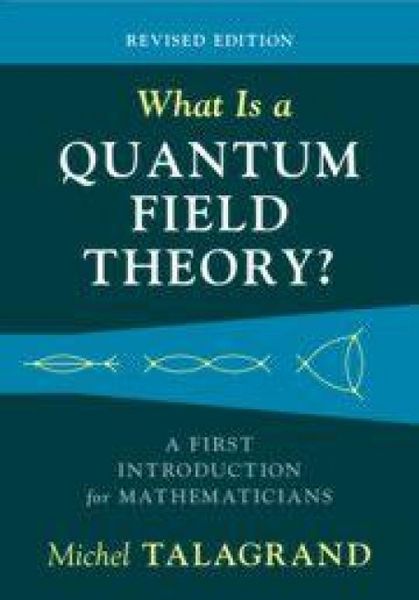
What Is a Quantum Field Theory? A First Introduction for Mathematicians
-
- Englisch ausgewählt
67,99 €
inkl. gesetzl. MwSt.,
Beschreibung
Produktdetails
Einband
Taschenbuch
Erscheinungsdatum
30.11.2026
Abbildungen
Worked examples or Exercises
Verlag
Cambridge AcademicSeitenzahl
814
Auflage
2 Revised edition
Sprache
Englisch
ISBN
978-1-00-961975-2
Quantum field theory (QFT) is one of the great achievements of physics, of profound interest to mathematicians, yet standard texts often assume a physicist's background or adopt an abstract mathematical perspective. This thoroughly updated edition bridges that gap. While maintaining a rigorous approach wherever possible, it focuses on explaining what physicists do and why, using precise mathematical language. Written for readers with a background in mathematics but no prior knowledge of physics, and largely self-contained, it presents both essential physical ideas and the necessary mathematical tools in detail. This revised edition has been improved throughout, with many clarifications to the text and the inclusion of solutions to selected exercises to enhance its use for self-study. It will appeal to mathematicians seeking an accessible path into QFT and to physics students wanting greater rigor.
Noch keine Bewertungen vorhanden
Verfassen Sie die erste Bewertung zu diesem Artikel
Helfen Sie anderen Kundinnen und Kunden durch Ihre Meinung.
Kurze Frage zu unserer Seite
Vielen Dank für Ihr Feedback
Wir nutzen Ihr Feedback, um unsere Produktseiten zu verbessern. Bitte haben Sie Verständnis, dass wir Ihnen keine Rückmeldung geben können. Falls Sie Kontakt mit uns aufnehmen möchten, können Sie sich aber gerne an unseren Kund*innenservice wenden.
zum Kundenservice