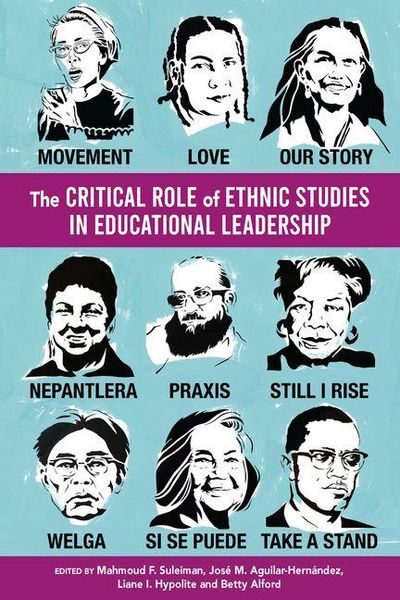
Produktbild: The Critical Role of Ethnic Studies in Educational Leadership
Vorbesteller Neu

The Critical Role of Ethnic Studies in Educational Leadership

Aus der Reihe Ethnic Studies Revival

51,99 €

inkl. gesetzl. MwSt., Versandkostenfrei


Beschreibung

Produktdetails

Einband

Taschenbuch

Erscheinungsdatum

31.08.2026

Herausgeber

Betty Alford + weitere

Verlag

Myers Education Press

Seitenzahl

300

Maße (L/B/H)

22,9/15,2/1,8 cm

Gewicht

363 g

Sprache

Englisch

ISBN

978-1-975508-89-0

Beschreibung

Portrait

Mahmoud Suleiman is a professor of teacher education at California State University, Bakersfield. He earned his Ph.D. from Arizona State University in 1993. He previously taught at the Maricopa Community College District, AZ; Arizona State University, Tempe; and Fort Hays State University, KS. He joined CSUB in 1999 and has taught a variety of credential and graduate courses in the areas of multiculturalism, reading/literacy, action research, instructional leadership, second language acquisition, equity, social justice and inclusion, cultural literacy, and international education; he also has published in extensively in these fields. During his tenure at CSUB, he served as Director of the Multiple Subject Credential Program and as Chair of the Teacher Education Department as well as Chair of the Advanced Educational Studies. He is currently serving as a Core Faculty member and an Acting Director of the Doctoral Program in Educational Leadership. He is a Fulbright Scholar (2009/2010) and completed his residency at the Bahrain Teachers College, University of Bahrain, Bahrain, as well as Fulbright Scholar (2016/2017) at the Faculty of Educational Sciences and Teachers' Training, An-Najah National University, Nablus, Palestine.

José M. Aguilar-Hernández is professor and doctoral program co-director in the Educational Leadership Department at Cal Poly Pomona. He is a first-generation academic, whose trajectory in higher education began at Moorpark Community College. Aguilar-Hernández transferred to UCLA, where he earned a B.A. in History and Chicana/o Studies, M.A. in Latin American Studies, and Ph.D. in Education. Aguilar-Hernández's research and teaching interests include higher education, student movements, and critical pedagogy. Using critical race theory in education & historical methods, his publications chart 1990s student of color activism in higher education in Southern California and engaging critical pedagogy in higher education. His publications appear in the International Journal of Qualitative Studies in Education, Latino Studies Journal, Association of Mexican American Educators Journal, Aztlan: A Journal of Chicano Studies, and in the First-Generation Faculty of Color: Reflections on Research, Teaching, and Service anthology published with Rutgers University Press. Aguilar- Hernández was awarded CPP College of Education and Integrative Studies' Advisor of the Year in 2024 and 2017. He is faculty coordinator of the CPP/Pomona Unified School District (PUSD) Ethnic Studies Dual Enrollment Program that enrolls high school students in "Introduction to Ethnic Studies," a course that grants students high school and college credit.

Liane I. Hypolite, PhD, is an associate professor in her sixth year teaching in the Educational Leadership Doctoral Program at California State Polytechnic University, Pomona. She earned a B.A. in Sociology and Psychology from Brandeis University, her Ed.M. from the Harvard Graduate School of Education, and her Ph.D. from the University of Southern California. Her research explores how students, educators, and community members find opportunities for success and well-being, despite navigating unjust systems.

Betty Alford, PhD, is a professor, department chair, and doctoral program co-director of the Educational Leadership Doctoral Program at California State Polytechnic University, Pomona. Alford's research agenda has centered on leadership for equity and excellence in high need schools, program improvement for educational leadership programs, and sustaining a college-going culture in schools. She has been a faculty member teaching in this doctoral program for eleven years with previous experience as a professor at Stephen F. Austin State University in Texas where she also served as doctoral program director and department chair. Alford attained her doctoral degree from the University of Texas at Austin.

Produktdetails

Einband

Taschenbuch

Erscheinungsdatum

31.08.2026

Herausgeber

Verlag

Myers Education Press

Seitenzahl

300

Maße (L/B/H)

22,9/15,2/1,8 cm

Gewicht

363 g

Sprache

Englisch

ISBN

978-1-975508-89-0

Herstelleradresse

Libri GmbH
Europaallee 1
36244 Bad Hersfeld
DE

Email: gpsr@libri.de

Noch keine Bewertungen vorhanden

Verfassen Sie die erste Bewertung zu diesem Artikel

Helfen Sie anderen Kundinnen und Kunden durch Ihre Meinung.

Kundinnen und Kunden meinen

Bewertungen (0)

  • Produktbild: The Critical Role of Ethnic Studies in Educational Leadership
  • Introduction

    PART I: Foundations of Ethnic Studies and Educational Leadership

    Chapter 1
    Counterhegemonic Leadership: Addressing the Challenges and Possibilities of Ethnic Studies Implementation for Educational Leaders
    Joaquín M. S. Noguera, Ernesto Colín, Kenzo K. Sung, Dolores Delgado Bernal, Cynthia M. Alcantar, Kyo Yamashiro, and William Pérez

    Chapter 2
    Rooted in Ethnic Studies: Designing Professional Development for Educational Leaders
    Tracie Tagamolila-Noriega, Arlene Daus-Magbual, and Allyson Tintiangco-Cubales

    Chapter 3
    Professional Development as Core: Transformative Ethnic Studies Leadership Through Culturally Responsive Practice and Collective Agency
    Felipe Mercado

    Chapter 4
    K-12 Ethnic Studies in California and Beyond: Implications from Initial Efforts to Institutionalize AB 101
    Rebeca Mireles-Rios, Lisa Park, Paula Sevilla, Fátima Andrade Martinez, Hui-Ling Malone, Adanari Zarate, and Edward Reyes

    Chapter 5
    The Historical Nexus of Race, Resistance, and Education
    David Sandles

    PART 2: Ethnic Studies and Its Application to Educational Leadership

    Chapter 6
    Documenting the Role of Student Activists on the Implementation of California's Assembly Bill
    Dayna Mitchell and José M. Aguilar-Hernández

    Chapter 7
    How Teachers' and Administrators' Perspectives Shape Effective Implementation of AB 101 Ethnic Studies Policy in California Schools
    Adam Bianchessi

    Chapter 8
    Understanding the Perspectives and Experiences of Teachers of Color Implementing Ethnic Studies Curriculum
    Alexia Lee

    Chapter 9
    Leveraging University-Interdistrict Partnerships Through Community-Based Learning Spaces for Ethnic Studies Educators and Leaders
    Jason Kim-Seda, Jazmin Chavez-Diaz, Ron Espiritu, Christina Mata, and Christine Sardo-Aska

    Chapter 10
    Implementing Ethnic Studies Across Disciplines in Higher Education: Faculty Voices and Pedagogical Insights
    Marisol Diaz, Gyasmine George-Williams, Liza Taylor, and Cindy Cordova Arroyo

    Chapter 11
    Culturally Responsive Leadership and Community Values: Pathways to Indigenous Student Success in Brazil and Hawai'i
    Jessica L. W. Miranda, Wagner Roberto do Amaral, and Joaquim Adiala Hara

    Chapter 12
    Towards Educational Leadership for Justice: Commitment to Prepare Educational Leaders to Integrate Ethnic Studies Into Their Leadership Practices
    Yesenia Fernández and Kitty Fortner

    PART 3: Case Studies and Practical Application

    Chapter 13
    More Than a Requirement: Re-envisioning Ethnic Studies Activism for Educational Leadership in the Central Valley
    Nora Cisneros, Jose G. Villigrán, Maria Gutierrez de Jesus, and Jeremiah Sataraka

    Chapter 14
    Ethnic Studies Curricular Considerations: A Case Study of Housing Discrimination in Kern County
    Jeremiah Sataraka, Donato Cruz, and Christopher Livingston

    Chapter 15
    Lessons from the Field: Birthing an Ethnic Studies Coalition, Community, and Movement in Stockton, California
    Aldrich Limpin Sabac and Gustavo Gonzalez

    Chapter 16
    Un Espacio Para Escuchar Voces: How a Student-Created Documentary Provided a Space for Spanish-Speaking Families to "Speak Up"
    Kimberly Zepeda and Bre-Evans Santiago

    Chapter 17
    Ethnic Studies as Critical Consciousness and Humanization: Implications for Educational Leadership
    Leticia Diaz-Garcia

    Chapter 18
    Leadership in Working Toward a District-Wide Focus on Equity: Implications for Ethnic Studies Implementation
    Betty Alford, Liane I. Hypolite, and Richard Navarro

    Chapter 19
    Supporting Ethnic Studies Through School Board Governance: A Case Study Approach
    Chris Cruz-Boone

    PART 4: Moving Forward: Creating Transformative Leadership

    Chapter 20
    Building Regenerative and Affirmative Chicana/o/x Studies for Latina/o/x Students: Xicanacimiento Ecosystems and K–20 Schools
    Elizabeth González Cárdenas, Natalia M. Toscano, Gustavo García, José Luis Serran Nájera, and Irene Vasquez

    Chapter 21
    Dangerous Ecologies: Analyzing the intersection of Special Education and Ethnic Studies
    Guadalupe M. Muñoz Moroyoqui

    Chapter 22
    Transformative Leadership and Ethnic Studies: Cultivating the Moral Courage to Strengthen Social Justice in K–12 Education
    Derrick M. Saenz-Payne

    About the Contributors

    Index