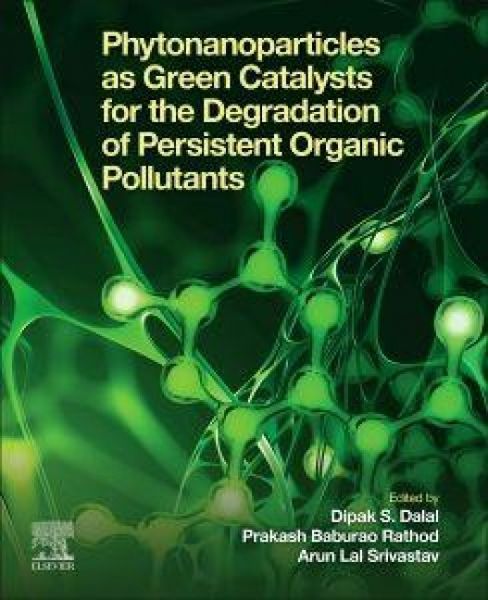
Produktbild: Phytonanoparticles as Green Catalysts for the Degradation of Persistent Organic Pollutants
Vorbesteller Neu

Phytonanoparticles as Green Catalysts for the Degradation of Persistent Organic Pollutants

249,99 €

inkl. gesetzl. MwSt., Versandkostenfrei


Beschreibung

Produktdetails

Einband

Taschenbuch

Erscheinungsdatum

01.01.2027

Herausgeber

Arun Lal Srivastav + weitere

Verlag

Elsevier

Seitenzahl

330

Maße (L/B)

23,5/19,1 cm

Gewicht

450 g

Sprache

Englisch

ISBN

978-0-443-44363-3

Beschreibung

Portrait

Dr. Arun Lal Srivastav is an Associate Professor in the Department of Applied Sciences at Chitkara University, Himachal Pradesh, India.

Dipak S. Dalal is a Professor and Director at the School of Chemical Sciences, Kavayitri Bahinabai Chaudhari North Maharashtra University (KBCNMU), Jalgaon, Maharashtra, India. He obtained his Ph.D. in Organic Chemistry from the same university and has over 16 years of academic experience. He teaches postgraduate courses in Organic Synthesis, Green Chemistry, Catalysis, and Environmentally Benign Reactions. His research spans Supramolecular Chemistry, Organic Solar Cells, Heterocyclic Chemistry, High-Energy Materials, Antitubercular Agents, Phytoremediation, and Waste Management. He has completed a major government-sponsored project on supramolecular catalysis and is presently working on another government-funded project. His academic excellence has been recognized through multiple awards, including the DST Fast Track Young Scientist Award, and the KBCNMU Publication Award in 2014, 2015, and 2016.

Prakash Baburao Rathod is an Assistant Professor at the School of Chemical Sciences, Kavayitri Bahinabai Chaudhari North Maharashtra University (KBCNMU), Jalgaon, Maharashtra, India. He holds a Ph.D. in Chemistry and is actively involved in teaching and research in the areas of materials chemistry and catalysis. His research primarily focuses on the synthesis and application of phytonanoparticles, functionalized magnetic nanomaterials, and polymer-based nanocomposites for use in catalysis, environmental remediation, and sustainable chemical processes. He has significantly contributed to green chemistry through the development of magnetically retrievable nanocatalysts and polymer-encapsulated nanoparticles that enable efficient and eco-friendly transformations. His recent research includes innovative approaches to nanoparticle synthesis, such as the use of γ-irradiated chitosan to enhance the antimicrobial activity of silver nanocomposites and the development of polymeric nanoassemblies for carbon–carbon coupling reactions. Through his continued research efforts, he is advancing the fields of nanotechnology, catalysis, and sustainable chemistry, addressing critical challenges in both environmental and industrial applications.

Produktdetails

Einband

Taschenbuch

Erscheinungsdatum

01.01.2027

Herausgeber

Verlag

Elsevier

Seitenzahl

330

Maße (L/B)

23,5/19,1 cm

Gewicht

450 g

Sprache

Englisch

ISBN

978-0-443-44363-3

Herstelleradresse

Libri GmbH
Europaallee 1
36244 Bad Hersfeld
DE

Email: gpsr@libri.de

Noch keine Bewertungen vorhanden

Verfassen Sie die erste Bewertung zu diesem Artikel

Helfen Sie anderen Kundinnen und Kunden durch Ihre Meinung.

Kundinnen und Kunden meinen

Bewertungen (0)

  • Produktbild: Phytonanoparticles as Green Catalysts for the Degradation of Persistent Organic Pollutants
  • 1. The environmental problem of persistent organic pollutants.
    2. Nanotechnology and green chemistry: A synergistic approach.
    3. Phytonanoparticles an eco-friendly catalyst
    4. Mechanism pathways and advantages of plant-mediated nanoparticles for the degradation of toxic organic pollutants
    5. Enhancing the phytonanoparticle efficiency.
    6. Adverse effect, stability and sustainability of phytonanoparticles in water treatment
    7. Phytonanoparticles use in decomposition of industrial dyes and textile effluents
    8. Degradation or decomposition of pharmaceutical and personal care pollutants Using Green Nanocatalysts
    9. Breakdown of herbicides and pesticides using phytonanoparticles.
    10. Advancement in the phytonanoparticles for enhanced catalysis
    11. Hybrid phytonanocomposites and their performance in water treatment.
    12. Kinetic studies of pollutant degradation by phytonanoparticles during water treatment.
    13. Challenges in large scale production and industrial application of phytonanocatalyst in water treatment.
    14. Integrating phytonanoparticles with smart technologies.
    15. Environmental cleanup with green nanotechnology.
    16. Environmental Impacts and policy frameworks for the application of engineered nanomaterials
    17. Fate of phyto-synthesized nanoparticles used in filtering membranes for the degradation of POPs including dyes
    18. Anticipated health and agricultural issues from emerging from POPs
    19. Case study: Application of Plant based Green Catalysts for the reduction of colour from industrial wastewater
    20. Case study: Degradation potential of phytonanoparticles for POPs from water