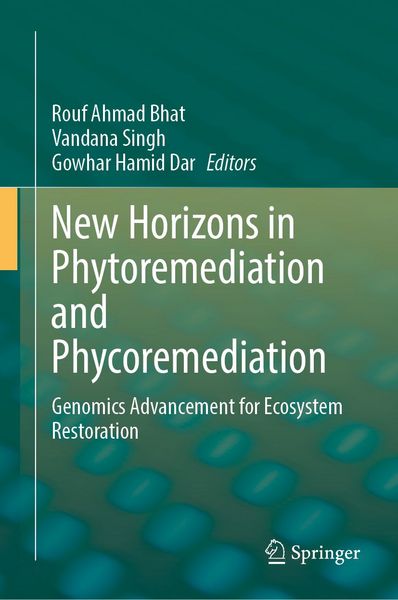
Produktbild: New Horizons in Phytoremediation and Phycoremediation
- 12% Neu

New Horizons in Phytoremediation and Phycoremediation Genomics Advancement for Ecosystem Restoration

12% sparen

206,99 € UVP 235,39 €

inkl. gesetzl. MwSt., Versandkostenfrei


Beschreibung

Produktdetails

Einband

Gebundene Ausgabe

Erscheinungsdatum

15.09.2026

Abbildungen

VI, 39 illus. in color., farbige Illustrationen

Herausgeber

Rouf Ahmad Bhat + weitere

Verlag

Springer

Seitenzahl

416

Maße (L/B)

23,5/15,5 cm

Sprache

Englisch

ISBN

978-3-032-32318-7

Beschreibung

Portrait

Dr. Rouf Ahmad Bhat (PhD) has pursued his doctorate at Sher-e-Kashmir University of Agricultural Sciences and Technology Kashmir (Division of Environmental Sciences) and presently working in the Department of School Education, Government of Jammu and Kashmir. Dr. Bhat has been teaching for the past 09 years. He is an author of more than 55 research articles (h-index 36; i-index 68; total citation 6000) and 50 book chapters, and has published more than 50 books with international publishers (Springer, Elsevier, CRC Press Taylor and Francis, Apple Academic Press, John Wiley, IGI Global). He has his specialization in Toxicology, Phytochemistry, and Phytoremediation. Dr. Bhat has presented and participated in numerous state, national, and international conferences, seminars, workshops, and symposium. Besides, he has worked as an associate environmental expert in World Bank-funded Flood Recovery Project and also the environmental support staff in the Asian Development Bank (ADB) funded development projects. He has received many awards, appreciations, and recognition for his services in the field of environmental sciences. He has served as an editorial board member and a reviewer of reputed international journals. 

Dr. Vandana Singh (Ph.D.), an Assistant Professor in the Department of Microbiology at School of Allied Health Sciences of Sharda University, holds a Ph.D. in Microbiology. She earned her M.Sc. in Microbiology from the University of Pune, Pune(India) and then She completed her Ph.D. in Microbiology from Noida International University, Noida (India). With over 14 years of teaching and research experience, her areas of expertise include Microbiology, Environmental microbiology, Food microbiology, Microbial nanotechnology, Nanomaterials, and microbial biotechnology.Her passion for microbiology is evident in her dedication to producing good-quality research, leading to numerous publications in the form of research articles, review papers and book chapters, in peer-reviewed and reputed journals. Her research interests focus on Microbial Fuel cells, Wastewater Treatment, Biological Wastewater Treatment, Environmental Biotechnology, Bioremediation of Water and Wastewater Treatment, Biodegradation, Biofilms production, Biosurfactant production, remediation of pollutants etc. 

Dr. Gowhar Hamid Dar (PhD) currently works as Assistant Professor in the Higher Education Department Govt. of J&K and is currently posted in Govt. Degree College Kulgam where he serves as Head, Department of Environmental Science and Coordinator, Internal Quality Assurance Cell (IQAC).  Before this he was posted at Govt. Sri Pratap College Srinagar, the oldest higher education institution of the UT of J&K. He has a PhD in Environmental Science with specialization in Environmental Microbiology (Fish Microbiology, Fish Pathology, Industrial Microbiology, Taxonomy and Limnology). He has been teaching postgraduate and graduate students for the past many years at Postgraduate. He has more than 70 research articles (h-index 18; i-index 25; total citation >1000) in international and national journals of repute and a more than 20 books with international publishers (Springer, Elsevier, CRC Press Taylor and Francis, Apple Academic Press, John Wiley, IGI Global) to his credit. Moreover, he supervises a number of students for the completion of degrees. He has been working on the Isolation, Identification and Characterization of microbes, their pathogenic behaviour and impact of pollution on development of diseases in fish fauna for the last several years. He has received many awards and appreciations for his services towards the science and development. Besides, he also acts as a member of various research and academic committees. Further, Dr. Dar is Principal Investigator and Co-Principal Investigator for different R&D projects sanctioned by Govt. of India and Govt. of Jammu and Kashmir.

Produktdetails

Einband

Gebundene Ausgabe

Erscheinungsdatum

15.09.2026

Abbildungen

VI, 39 illus. in color., farbige Illustrationen

Herausgeber

Verlag

Springer

Seitenzahl

416

Maße (L/B)

23,5/15,5 cm

Sprache

Englisch

ISBN

978-3-032-32318-7

Herstelleradresse

Springer International Publishing AG
Gewerbestr. 11
6330 Cham
Schweiz
Url: www.springer.com

Noch keine Bewertungen vorhanden

Verfassen Sie die erste Bewertung zu diesem Artikel

Helfen Sie anderen Kundinnen und Kunden durch Ihre Meinung.

Kundinnen und Kunden meinen

Bewertungen (0)

  • Produktbild: New Horizons in Phytoremediation and Phycoremediation
  • Phytoremediation of Nuisance Pollution.- Mechanism of Phytoremediation for Degradation of Toxic Chemical Substances.- Genomics and Metagenomics of Phycoremediation: Advancements and Challenges.- The role of metabolomics in phytoremediation and phycoremediation A genomic approach.- Genome Editing for Enhanced Phytoremediation Efficiency in Hazardous Nanomaterials.- Genomics approaches for understanding and improving phytoremediation.- Genetically Modified Phytoremediation for Organic Xenobiotic Pollution Mitigation.- Phytoremediation of Inorganic Pollutants.- Genetically Modified Organisms a novel approach for Phytoremediation of Volatile Organic Compounds.- Phytochelatins and metallothioneins Protein Ingredients for Heavy Metal Detoxification.- Advances and Modern Concepts in Phytoremediation for Sustainable Future.- Transgenic plants and Endophytes A synergistic approach to phytoremediation of pharmaceutical wastes.- Role of microalgae in ecosystem restoration a metagenomic approach.- Phycosynthesis of silver and gold nanoparticles to environmental pollution remediation.- Genetic alteration of Phycoremediator for Abatement of Toxic Azo Dyes from the Environment.- Advancing Genomic Based Strategies in Phytoremediation and Phycoremediation for Future Ecosystem Restoration.