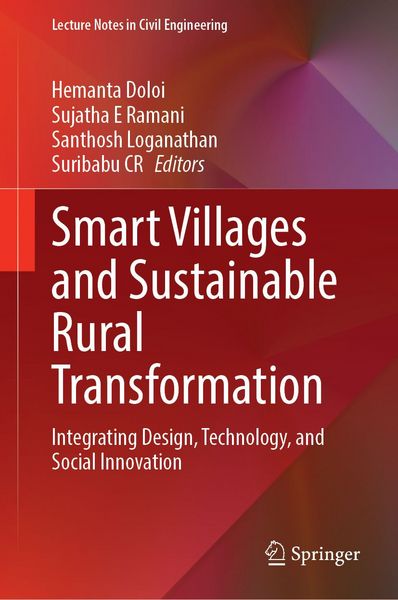
Smart Villages and Sustainable Rural Transformation Integrating Design, Technology, and Social Innovation
-
- Englisch ausgewählt
245,99 €
inkl. gesetzl. MwSt.,
Beschreibung
Produktdetails
Einband
Gebundene Ausgabe
Erscheinungsdatum
07.10.2026
Abbildungen
V, 290 p. 148 illus., 74 illus. in color.
Herausgeber
Hemanta Doloi + weitereVerlag
Springer SingaporeSeitenzahl
290
Maße (B/H)
15,5/23,5 cm
Sprache
Englisch
ISBN
978-981-9247-90-5
This book presents the latest global research and applied case studies advancing the Smart Villages agenda for climate-positive regional development. Drawing from papers presented at the International Conference on Smart Villages and Rural Development (COSVARD 2025), the book unites scholars, engineers, planners, and policymakers committed to redefining rural futures through integrated, data-enabled, and circular infrastructure systems.
Across the world, rural regions, home to more than 40% of the global population, many of whom continue to live in underdeveloped conditions, are facing converging pressures—housing shortages, resource constraints, climate impacts, and uneven economic growth. The Smart Village paradigm responds by treating rural settlements not as residual spaces but as active systems where food, energy, water, and housing (FEWH) cycles operate in closed loops. The chapters collected here explore how such systems can expand housing supply, regenerate ecosystems, and build social resilience while contributing to national decarbonization targets
Section I establishes the theoretical and policy foundations of Smart Villages through comparative perspectives from India, Europe, and Africa, tracing the evolution from early Garden City principles to con-temporary networked settlements. Section II addresses governance, planning, and nature-based transitions, showing how participatory and bioclimatic design practices enable inclusive and adaptive rural re-generation. Section III focuses on circular and decentralized infrastructure systems—waste management, water reuse, and modular building reuse—that demonstrate how resource efficiency and affordability can be achieved simultaneously.
Section IV turns to material innovation, presenting frontier research on self-healing concretes, bio-based composites, lightweight geopolymers, and nano-enhanced concretes designed for low-carbon construction in regional contexts. Section V concludes with rigorous laboratory and field studies evaluating material and structural performance, soil-material interactions, and durability—all critical to ensuring that Smart Village construction achieves both innovation and safety.
By bridging engineering science, planning, and sustainability governance, this book positions Smart Villages as a replicable systems model for twenty-first-century rural transformation.
Noch keine Bewertungen vorhanden
Verfassen Sie die erste Bewertung zu diesem Artikel
Helfen Sie anderen Kundinnen und Kunden durch Ihre Meinung.
Kurze Frage zu unserer Seite
Vielen Dank für Ihr Feedback
Wir nutzen Ihr Feedback, um unsere Produktseiten zu verbessern. Bitte haben Sie Verständnis, dass wir Ihnen keine Rückmeldung geben können. Falls Sie Kontakt mit uns aufnehmen möchten, können Sie sich aber gerne an unseren Kund*innenservice wenden.
zum Kundenservice