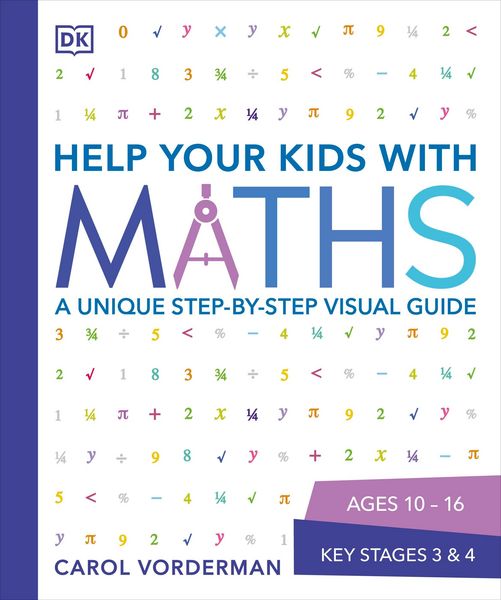
Produktbild: Help Your Kids with Maths, Ages 10-16 (Key Stages 3-4)
Gebraucht - 59%

Help Your Kids with Maths, Ages 10-16 (Key Stages 3-4) A Unique Step-by-Step Visual Guide, Revision and Reference

59% sparen

7,34 € 17,99 € *

inkl. gesetzl. MwSt., Versandkostenfrei

*ggü. gebundenem Ladenpreis bzw. UVP für Neuware.

Lieferung nach Hause

Beschreibung

Produktdetails

Zustand

Akzeptabel

Einband

Taschenbuch

Erscheinungsdatum

01.07.2014

Abbildungen

w. Illustrationen

Verlag

Dorling Kindersley UK

Seitenzahl

264

Maße (L/B/H)

23,8/19,7/2,2 cm

Gewicht

824 g

Sprache

Englisch

EAN

2710005476165

Beschreibung

Produktdetails

Zustand

Akzeptabel

Einband

Taschenbuch

Erscheinungsdatum

01.07.2014

Abbildungen

w. Illustrationen

Verlag

Dorling Kindersley UK

Seitenzahl

264

Maße (L/B/H)

23,8/19,7/2,2 cm

Gewicht

824 g

Sprache

Englisch

EAN

2710005476165

Herstelleradresse

Libri GmbH
Europaallee 1
36244 Bad Hersfeld
DE

Email: GPSR Kontakt

Noch keine Bewertungen vorhanden

Verfassen Sie die erste Bewertung zu diesem Artikel

Helfen Sie anderen Kundinnen und Kunden durch Ihre Meinung.

Kundinnen und Kunden meinen

Bewertungen (0)

  • Produktbild: Help Your Kids with Maths, Ages 10-16 (Key Stages 3-4)
    • 1: Foreword
    • 2: Introduction
    • 3: Numbers
      • 1: Introducing numbers
      • 2: Addition
      • 3: Subtraction
      • 4: Multiplication
      • 5: Division
      • 6: Prime numbers
      • 7: Units of measurement
      • 8: Telling the time
      • 9: Roman numerals
      • 10: Positive and negative numbers
      • 11: Powers and roots
      • 12: Surds
      • 13: Standard form
      • 14: Decimals
      • 15: Binary numbers
      • 16: Fractions
      • 17: Ratio and proportion
      • 18: Percentages
      • 19: Converting fractions, decimals, and percentages
      • 20: Mental maths
      • 21: Rounding off
      • 22: Using a calculator
      • 23: Personal finance
      • 24: Business finance
    • 4: Geometry
      • 1: What is geometry?
      • 2: Tools in geometry
      • 3: Angles
      • 4: Straight lines
      • 5: Symmetry
      • 6: Coordinates
      • 7: Vectors
      • 8: Translations
      • 9: Rotations
      • 10: Reflections
      • 11: Enlargements
      • 12: Scale drawings
      • 13: Bearings
      • 14: Constructions
      • 15: Loci
      • 16: Triangles
      • 17: Constructing triangles
      • 18: Congruent triangles
      • 19: Area of a triangle
      • 20: Similar triangles
      • 21: Pythagoras' theorem
      • 22: Quadrilaterals
      • 23: Polygons
      • 24: Circles
      • 25: Circumference and diameter
      • 26: Area of a circle
      • 27: Angles in a circle
      • 28: Chords and cyclic quadrilaterals
      • 29: Tangents
      • 30: Arcs
      • 31: Sectors
      • 32: Solids
      • 33: Volumes
      • 34: Surface area of solids
    • 5: Trigonometry
      • 1: What is trigonometry?
      • 2: Using formulas in trigonometry
      • 3: Finding missing sides
      • 4: Finding missing angles
    • 6: Algebra
      • 1: What is algebra?
      • 2: Sequences
      • 3: Working with expressions
      • 4: Expanding and factorizing expressions
      • 5: Quadratic expressions
      • 6: Formulas
      • 7: Solving equations
      • 8: Linear graphs
      • 9: Simultaneous equations
      • 10: Factorizing quadratic equations
      • 11: The quadratic formula
      • 12: Quadratic graphs
      • 13: Inequalities
    • 7: Statistics
      • 1: What is statistics?
      • 2: Collecting and organizing data
      • 3: Bar charts
      • 4: Pie charts
      • 5: Line graphs
      • 6: Averages
      • 7: Moving averages
      • 8: Measuring spread
      • 9: Histograms
      • 10: Scatter diagrams
    • 8: Probability
      • 1: What is probability?
      • 2: Expectation and reality
      • 3: Combined probabilities
      • 4: Dependent events
      • 5: Tree diagrams
    • 9: Reference section
    • 10: Glossary
    • 11: Index
    • 12: Acknowledgements