Beschreibung
Produktdetails
Einband
Gebundene Ausgabe
Erscheinungsdatum
28.07.2026
Verlag
Aixi MediaSeitenzahl
284
Maße (L/B/H)
22,9/15,2/2,4 cm
Gewicht
685 g
Sprache
Englisch
ISBN
978-1-06-682841-8
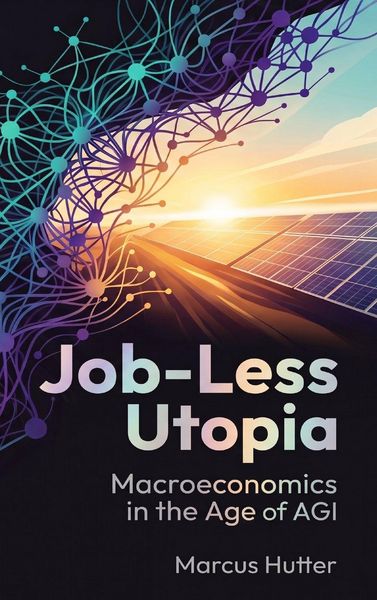
What happens when machines do every job better than you?
Artificial general intelligence and advanced robotics will automate virtually all cognitive and physical tasks within a single generation.The question is not whether this will happen, but what we do when it does. Three dominant responses get it wrong: optimists who trust history to repeat, pessimists who equate job loss with collapse, and skeptics who deny the technology altogether. All three fixate on jobs rather than goods and services. Job-Less Utopia argues for a fourth position: Post-Labor Prosperity. If machines produce the same or greater output, society's material wealth is undiminished. The real challenge is distribution, not production. Under adequate redistribution, mass unemployment is not a catastrophe: it is a liberation. The book develops this case along thirteen theses spanning six domains:
- Economics: Near-zero marginal costs, self-replicatingcapital, and solving the land bottleneck.
- Employment: Why the historical pattern of compensatingjob creation will break, and why forcing full employment producessocially wasteful bullshit jobs.
- Welfare design: How multiple complementary tax instrumentscan finance guaranteed income, even cost-neutrally.
- Democracy: Why functioning democracies will self-correcttoward redistribution as the displaced majority gains electoralpower.
- Meaning: Why the "crisis of meaning" is a transientcultural artifact, neither a natural nor unresolvable humanlimitation.
- Geopolitics: How AI rentierism, trade asymmetries, andcapital flight can be managed through proven policy tools.
Why this book is different: Nearly every individual idea here has appeared before. What is new is the systematic architecture: the first single-volume treatment integrating economics, welfare design, democratic stability, the question of meaning, and international coordination into one mutually reinforcing argument. The book includes a micro-level fiscal-feasibility proof, a Wittgensteinian property-cluster definition of"job," a three-phase UBI transition roadmap with pre-legislated automation triggers, and a new tax category: the bullshit tax.Extensively illustrated with 41 diagrams and 30 tables, and grounded in over 250 scholarly references.
Dr. Marcus Hutter is a polymath whose 35-year R&D career has ranged from medical software development to physics, mathematics, computer science, philosophy, and artificial intelligence. More recently his work has focused on AGI's economic, political, and social implications. He has been Professor at the Australian National University for most of his career.
Noch keine Bewertungen vorhanden
Verfassen Sie die erste Bewertung zu diesem Artikel
Helfen Sie anderen Kundinnen und Kunden durch Ihre Meinung.
Kurze Frage zu unserer Seite
Vielen Dank für Ihr Feedback
Wir nutzen Ihr Feedback, um unsere Produktseiten zu verbessern. Bitte haben Sie Verständnis, dass wir Ihnen keine Rückmeldung geben können. Falls Sie Kontakt mit uns aufnehmen möchten, können Sie sich aber gerne an unseren Kund*innenservice wenden.
zum Kundenservice