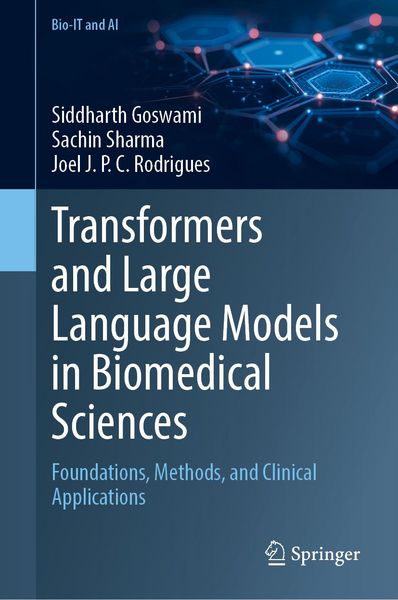
Transformers and Large Language Models in Biomedical Sciences Foundations, Methods, and Clinical Applications
-
- Englisch ausgewählt
193,99 €
inkl. gesetzl. MwSt.,
Beschreibung
Produktdetails
Einband
Gebundene Ausgabe
Erscheinungsdatum
16.01.2027
Abbildungen
XVI, 363 p. 35 illus. in color.
Verlag
SpringerSeitenzahl
363
Maße (B/H)
15,5/23,5 cm
Sprache
Englisch
ISBN
978-3-032-38922-0
Transformers and Large Language Models in Biomedical Sciences: Foundations, Methods, and Clinical Applications is a comprehensive, practice-driven textbook that links the mathematics of attention and scaling laws with real biomedical problems across molecules, omics data, and clinical narratives. It guides readers through transformer and LLM architectures, biomedical NLP foundations, key corpora and knowledge bases (PubMed, MIMIC, BLURB, MedQA), privacy-preserving data curation and de-identification, pretraining and domain adaptation strategies, and detailed comparisons of models such as BioBERT, PubMedBERT, BioGPT, MedPaLM, GPT-4-class systems, and emerging LLaMA-based medical LLMs.
The book is applicable to biomedical informatics, bioinformatics, computational biology, health data science, clinical AI, digital health, pharmaceutical sciences, and translational medicine, and supports courses in machine learning in healthcare, biomedical NLP, clinical decision support, health information technology, and medical AI governance. It can be adopted in undergraduate AI/ML and bioinformatics electives, postgraduate programs in biomedical informatics, health data science, and computer science, as well as doctoral and postdoctoral research training where students must move from theory to deployable systems. Its novelty lies in unifying rigorous mathematical foundations, domain-specific NLP, regulatory and governance frameworks (HIPAA, GDPR, FDA/EMA SaMD, EU AI Act), and hands-on deployment guidance in one coherent volume, making it directly usable for real-world projects and capstones rather than only theory.
The best part of the book is its learning ecosystem: every chapter offers clear learning objectives, exam-style questions (Objective & Subjective), case studies, and progressively challenging coding projects that use real biomedical corpora to build de-identification pipelines, clinical summarizers, retrieval-augmented question-answering systems, and drug discovery assistants—helping students and researchers move from understanding transformers and LLMs to actually implementing, testing, and responsibly using them in authentic clinical and research settings.
Noch keine Bewertungen vorhanden
Verfassen Sie die erste Bewertung zu diesem Artikel
Helfen Sie anderen Kundinnen und Kunden durch Ihre Meinung.
Kurze Frage zu unserer Seite
Vielen Dank für Ihr Feedback
Wir nutzen Ihr Feedback, um unsere Produktseiten zu verbessern. Bitte haben Sie Verständnis, dass wir Ihnen keine Rückmeldung geben können. Falls Sie Kontakt mit uns aufnehmen möchten, können Sie sich aber gerne an unseren Kund*innenservice wenden.
zum Kundenservice