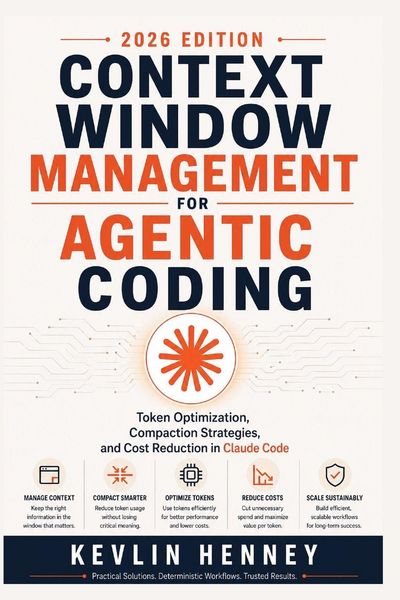
Context Window Management for Agentic Coding Token Optimization, Compaction Strategies, and Cost Reduction in Claude Code
-
- Englisch ausgewählt
15,99 €
inkl. gesetzl. MwSt.,
Beschreibung
Produktdetails
Einband
Taschenbuch
Erscheinungsdatum
11.08.2026
Verlag
Independently PublishedSeitenzahl
112
Maße (L/B/H)
22,9/15,2/0,7 cm
Gewicht
148 g
Sprache
Englisch
EAN
9798192210369
The context window is one of the most important resources in an agentic coding workflow. During long development sessions, thousands of lines of tool output, file contents, test results, search results, and conversation history can accumulate until useful instructions are buried beneath stale information. As the signal-to-noise ratio falls, an AI coding agent may lose focus, repeat failed actions, or misunderstand important architectural constraints.
Context Window Management for Agentic Coding provides an engineering-focused framework for managing this problem. Rather than offering generic advice to simply use fewer tokens, this guide examines the components that contribute to active context and shows how developers can control them deliberately.
You will learn to distinguish between fixed system instructions, tool definitions, static instruction files, conversation history, and volatile tool outputs. By treating context consumption as an engineering resource, you can identify unnecessary overhead and design workflows that preserve useful information while reducing waste.
The book explains the difference between compaction and clearing, including when lossy summarization can preserve productive momentum and when a clean state reset is the better choice. You will also learn why proactive context maintenance is preferable to waiting until an agent reaches a hard limit or begins producing unreliable results.
Advanced optimization techniques include path-scoped instruction structures that prevent unrelated project rules from being loaded into every task. A frontend session should not repeatedly pay the context cost of backend-specific instructions when those rules are irrelevant to the current work.
The guide also explores prompt caching, sub-task context firewalls, parameterized output scoping, and other techniques for controlling token consumption across multi-hour development sessions.
Optimization methodologies covered:
- Parameterized Output Scoping: Reduce unnecessary tokens from large search and tool results.
- Compaction vs. Clearing: Preserve useful momentum while removing redundant history.
- Path-Scoped Rule Structures: Load instructions only where they are relevant.
- Prompt Cache Maximization: Separate stable rules from frequently changing information.
- Sub-Task Context Firewalls: Route verbose exploration away from the primary workflow.
This is an operational guide for developers, technical leads, platform engineers, and AI practitioners who need reliable performance from autonomous coding environments. Learn to control context, reduce hidden token waste, and keep agentic software engineering workflows focused and financially sustainable.
Noch keine Bewertungen vorhanden
Verfassen Sie die erste Bewertung zu diesem Artikel
Helfen Sie anderen Kundinnen und Kunden durch Ihre Meinung.
Kurze Frage zu unserer Seite
Vielen Dank für Ihr Feedback
Wir nutzen Ihr Feedback, um unsere Produktseiten zu verbessern. Bitte haben Sie Verständnis, dass wir Ihnen keine Rückmeldung geben können. Falls Sie Kontakt mit uns aufnehmen möchten, können Sie sich aber gerne an unseren Kund*innenservice wenden.
zum Kundenservice