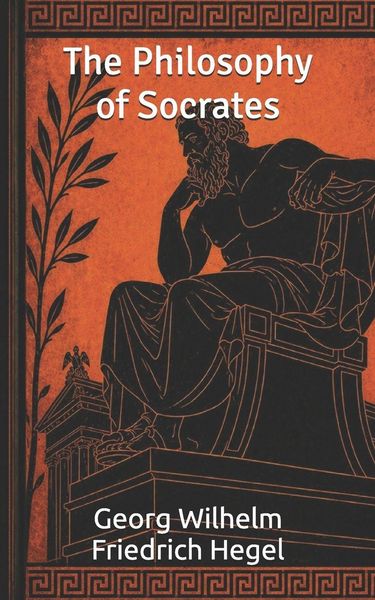
The Philosophy of Socrates
-
- Englisch ausgewählt
9,99 €
inkl. gesetzl. MwSt.,
Beschreibung
Produktdetails
Einband
Taschenbuch
Erscheinungsdatum
20.07.2026
Verlag
Independently PublishedSeitenzahl
138
Maße (L/B/H)
20,3/12,7/0,8 cm
Gewicht
145 g
Übersetzt von
Lucas Praxedes
Sprache
Englisch
EAN
9798188201210
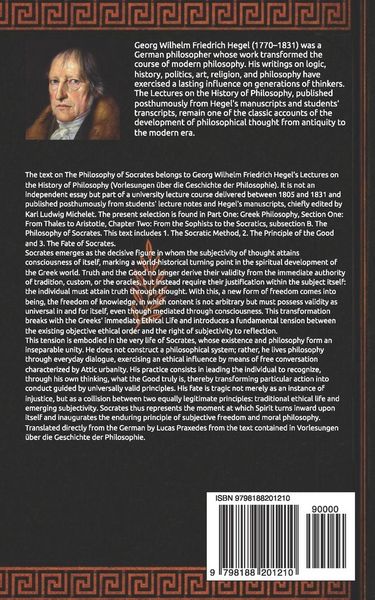
The text on The Philosophy of Socrates belongs to Georg Wilhelm Friedrich Hegel's Lectures on the History of Philosophy (Vorlesungen über die Geschichte der Philosophie). It is not an independent essay but part of a university lecture course delivered between 1805 and 1831 and published posthumously from students' lecture notes and Hegel's manuscripts, chiefly edited by Karl Ludwig Michelet. The present selection is found in Part One: Greek Philosophy, Section One: From Thales to Aristotle, Chapter Two: From the Sophists to the Socratics, subsection B. The Philosophy of Socrates. This text includes 1. The Socratic Method, 2. The Principle of the Good and 3. The Fate of Socrates.
Socrates emerges as the decisive figure in whom the subjectivity of thought attains consciousness of itself, marking a world-historical turning point in the spiritual development of the Greek world. Truth and the Good no longer derive their validity from the immediate authority of tradition, custom, or the oracles, but instead require their justification within the subject itself: the individual must attain truth through thought. With this, a new form of freedom comes into being, the freedom of knowledge, in which content is not arbitrary but must possess validity as universal in and for itself, even though mediated through consciousness. This transformation breaks with the Greeks' immediate Ethical Life and introduces a fundamental tension between the existing objective ethical order and the right of subjectivity to reflection.
This tension is embodied in the very life of Socrates, whose existence and philosophy form an inseparable unity. He does not construct a philosophical system; rather, he lives philosophy through everyday dialogue, exercising an ethical influence by means of free conversation characterized by Attic urbanity. His practice consists in leading the individual to recognize, through his own thinking, what the Good truly is, thereby transforming particular action into conduct guided by universally valid principles. His fate is tragic not merely as an instance of injustice, but as a collision between two equally legitimate principles: traditional ethical life and emerging subjectivity. Socrates thus represents the moment at which Spirit turns inward upon itself and inaugurates the enduring principle of subjective freedom and moral philosophy.
Translated directly from the German by Lucas Praxedes from the text contained in Vorlesungen über die Geschichte der Philosophie. Translator's notes are indicated throughout the text by "(Tr.)."
Noch keine Bewertungen vorhanden
Verfassen Sie die erste Bewertung zu diesem Artikel
Helfen Sie anderen Kundinnen und Kunden durch Ihre Meinung.
Kurze Frage zu unserer Seite
Vielen Dank für Ihr Feedback
Wir nutzen Ihr Feedback, um unsere Produktseiten zu verbessern. Bitte haben Sie Verständnis, dass wir Ihnen keine Rückmeldung geben können. Falls Sie Kontakt mit uns aufnehmen möchten, können Sie sich aber gerne an unseren Kund*innenservice wenden.
zum Kundenservice