• Produktbild: Advances in X-Ray Analysis
  • Produktbild: Advances in X-Ray Analysis
- 12%

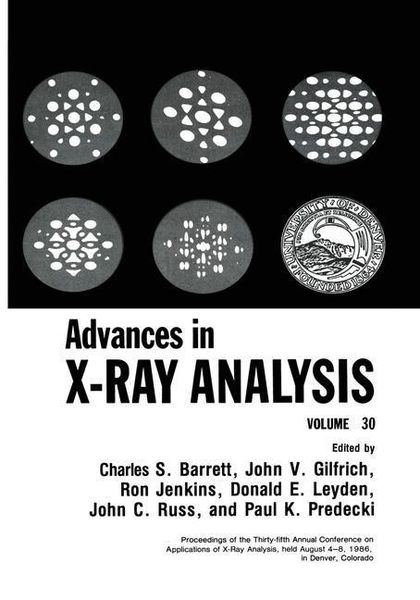
Advances in X-Ray Analysis Volume 30

12% sparen

74,99 € UVP 85,55 €

inkl. gesetzl. MwSt., Versandkostenfrei


Beschreibung

Produktdetails

Einband

Gebundene Ausgabe

Erscheinungsdatum

05.03.1999

Verlag

Springer Us

Seitenzahl

602

Gewicht

1250 g

Auflage

1987 edition

Sprache

Englisch

ISBN

978-0-306-42690-2

Beschreibung

Produktdetails

Einband

Gebundene Ausgabe

Erscheinungsdatum

05.03.1999

Verlag

Springer Us

Seitenzahl

602

Gewicht

1250 g

Auflage

1987 edition

Sprache

Englisch

ISBN

978-0-306-42690-2

Herstelleradresse

Libri GmbH
Europaallee 1
36244 Bad Hersfeld
DE

Email: gpsr@libri.de

Kundinnen und Kunden meinen

0 Bewertungen

Informationen zu Bewertungen

Zur Abgabe einer Bewertung ist eine Anmeldung im Konto notwendig. Die Authentizität der Bewertungen wird von uns nicht überprüft. Wir behalten uns vor, Bewertungstexte, die unseren Richtlinien widersprechen, entsprechend zu kürzen oder zu löschen.

Die Bewertungen sind nach Format, Anzahl Sterne und Datum sortiert.

Verfassen Sie die erste Bewertung zu diesem Artikel

Helfen Sie anderen Kund*innen durch Ihre Meinung

Kundinnen und Kunden meinen

0 Bewertungen filtern

  • Produktbild: Advances in X-Ray Analysis
  • Produktbild: Advances in X-Ray Analysis
  • I. Trends in XRF: A World Perspective (Plenary Session).- XRF in North America.- X-Ray Fluorescence Analysis (XRF) in Europe.- XRF in Japan and China.- Personal Observations.- Personal Observations.- II. XRF Techniques and Instrumentation.- X-Ray Microfluorescence of Geologic Materials.- Parameters Affecting X-Ray Microfluorescence (XRMF) Analysis.- Imaging Techniques for X-Ray Fluorescence and X-Ray Diffraction.- X-Ray Microanalysis for Alloy Design.- High Spatial Resolution in X-Ray Fluorescence.- Low Level Iodine Detection by TXRF in a Reactor Safety Simulation Experiment.- Robotic Automation Applied to X-Ray Fluorescence Analysis.- III. XRF Fundamental Parameters and Data Analysis.- Advances in Fundamental-Parameter Methods for Quantitative XRFA.- X-Ray Fluorescence Analysis of Geological Materials Using Rousseau’s Fundamental Algorithm.- Application of the Inverse Monte Carlo Method to Energy-Dispersive X-Ray Fluorescence.- Monte Carlo Simulation of the X-Ray Fluorescence Spectra From Multielement Homogeneous and Heterogeneous Samples.- Quantitative Analysis of Odd-Shaped Samples by X-Ray Fluorescence Spectrometry Using Intensity Ratios.- Background Intensities and their Utilization in Quantitative Analysis by Monochromatically Excited Energy-Dispersive X-Ray Fluorescence.- Standardless EDXRF Analysis of Cations in Ion-Exchange Resin-Impregnated Membrances.- Use of Scattered Secondary Target Radiation in EDXRF Analysis: A Fundamental-Parameter Method for Matrix Correction.- Comparison of Dilution Strategies for Dealing with Unanalyzed Elements in X-Ray Fluorescence Analyses.- IV. Recent Developments in XRF Dispersion Devices.- The Use of Layered Synthetic Microstructures for Quantitative Analysis of Elements: Boron to Magnesium.- The Analysis of Carbon and Other Light Elements Using Layered Synthetic Microstructures.- Layered Synthetic Microstructure in Sequential and Simultaneous X-Ray Spectrometry.- Measurement of Soft and Ultrasoft X-Rays With Total Reflection Monochromator.- Comparison of Dual-Channel Wavelength and Secondary-Target Energy-Dispersive X-Ray Spectrometers.- V. XRF Applications; Fuels and Lubricants, Metals and Alloys, Geological, Heavy Element, other.- The Efficiency of the Recessed Source Geometry for EDXRF Analysis of Metal Impurities in Oils.- X-Ray Fluorescence Analysis of Sulfur and Trace Elements in Coal and Oil Tar Pitches, Asphalts and Other Bituminous Compounds.- A Comparison of Several Sample Preparation Techniques for the Analysis of Fly Ash.- Advances in High-Resolution Studies of the Chemical Effects in the Molybdenum L Heavy-Ion-Induced X-Ray Satellite Emission (HIXSE) Spectra.- Energy Dispersive Analysis for Quality Assurance of Aluminum Alloys.- Multielement Preconcentration of Rare Earth Elements for their Determination at ppm-Levels in Geological Samples.- Wide Area Networking of XRF Generated Geochemical Data in a National Geological Survey.- Energy-Dispersive X-Ray Techniques for Accurate Heavy Element Assay..- Applications of X-Ray Fluorescence Scans of Single Strands of Hair: Actual and Potential.- Application of EDXRF Analysis to Continuous Industrial Process Monitoring.- X-Ray Fluorescence Determination of Trace Elements in Complicated Matrices.- An X-Ray Fluorescent Spectrometer for the Measurement of Thin Layered Materials on Silicon Wafers.- Automated Quantitative XRF Analysis of Soda-Lime Glass Utilizing Pattern Recognition.- VI. Quantitative Phase Analysis by XRD.- The Use of Mass Absorption in Quantitative X-Ray Diffraction Analysis.- Powder Diffraction Profiles and the Pearson VII Distribution.- Observed and Calculated XRPD Intensities for Single Substance Specimens.- Rapid Non-Destructive X-Ray Characterization of Solid Fuels/Propellents.- On-Stream X-Ray Diffraction Analyzer for Mineral Concentrators.- VII. Synchrotron and Neutron Diffraction.- Lattice Parameter Determination using Synchrotron Powder Data.- Synchrotron Radiation Applied to Computer Indexing.- Synchrotron X-Ray Scattering for the Structural Characterization of Catalysts.- Thermal Expansion Behavior of Pure and Doped Cordierite by Time-of-Flight Neutron Diffraction.- VIII. Advances in XRD Instrumentation and Procedures.- Instrumental Capabilities in X-Ray Diffraction Analysis: Comparative Techniques.- A New High-Temperature Camera for Diffraction Studies Above 2200°C ..- Use of X-Ray Curved Sensitive Position Detector for Simultaneous Measurement of Several Pole Figures.- A Quantitative Texture Analysis of Pluri-Crystals by Texture Goniometry.- Computing X-Ray Powder Diffraction Intensities and Bragg Angles Using a Microcomputer.- The Effects of Extinction on X-Ray Powder Diffraction Intensities.- Analysis of Surface Layers and Thin Films by Low Incident Angle X-Ray Diffraction.- IX, HIgh Temperature and Non-Ambient Powder Diffraction Applications.- X-Ray Diffraction Studies Under Non-Ambient Conditions: Application to Transition-Metal Dichalcogenide Solid Lubricants.- High Temperature X-Ray Diffraction Study of Sol-Gel Derived Pb(ZrxTi1-x)O3 Powders.- In Situ Crystallization Measurements on Fe-Zr Glasses Using an Automated High Temperature Diffractometer with a Position Sensitive Detector.- Use of Dow-Developed DSC/XRD/MS in the Study of Several Model Copper-Based Catalyst Systems.- Relationship Between Thermal Expansion and Crystal Chemical Parameters in Diborides.- X. X-Ray Stress Analysis, Fractography.- Experimental Methods for Determination of Precision and Estimation of Accuracy in XRD Residual Stress Measurement.- Design of a Real-Time Two-Dimensional Residual Stress Analyzer.- High Resolution Digital X-Ray Rocking Curve Topography.- X-Ray Diffraction Study of Fracture Surface Made by Fracture Toughness Tests of Blunt Notched CT Specimen of Aluminum Alloy.- X-Ray Fraetography of Fracture Surface of Alumina Ceramics.- XI, Analytical X-ray Safety (Workshop Presentations).- Dosimetry of X-Ray Beams: The Measure of the Problem.- Some Examples of Failure in X-Ray Safety.- Controlling Laboratory Conditions: Preventing the Problem, the Health Physicist’s Viewpoint.- Analytical X-Ray Safety at Lawrence Livermore National Laboratory.- Author Index.