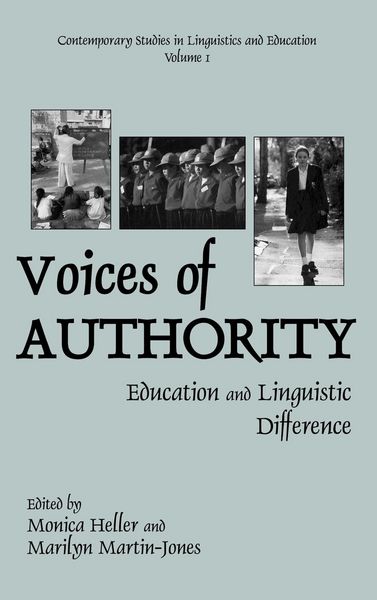
Voices of Authority Education and Linguistic Difference
-
- Hardcover ausgewählt
- Taschenbuch
-
Sprache:Englisch
114,99 €
inkl. gesetzl. MwSt.,
Beschreibung
Produktdetails
Einband
Gebundene Ausgabe
Altersempfehlung
7 - 17 Jahr(e)
Erscheinungsdatum
28.02.2001
Herausgeber
Heller Monica + weitereVerlag
Bloomsbury USASeitenzahl
456
Maße (L/B/H)
23,5/15,7/3,1 cm
Gewicht
886 g
Sprache
Englisch
ISBN
978-1-56750-530-6
This collection of case studies from around the world examines how struggles for equality unfold in policies, programs, and practices in educational settings in multilingual contexts. Using sociolinguistic, interactional and discourse analysis, Heller and Martin-Jones examine the complex ways in which dominant ideologies of education, pedagogy, language and identity intersect in a wide variety of educational settings. They focus in particular on how those ideologies are reproduced or challenged, and on the consequences of such processes for changing or maintaining social relations of difference and inequality. Written for policy-makers, educators, and anyone else interested in education and multilingualism, the book places questions of power at the center of thinking about language and education.
This collection of case studies from around the world examines how struggles for equality unfold in policies, programs, and practices in educational settings in multilingual contexts. Using sociolinguistic, interactional and discourse analysis, Heller and Martin-Jones examine the complex ways in which dominant ideologies of education, pedagogy, language, and identity intersect in a wide variety of educational settings. They focus in particular on how those ideologies are reproduced or challenged, and on the consequences of such processes for changing or maintaining social relations of difference and inequality. Written for policy-makers, educators, and anyone else interested in education and multilingualism, the book places questions of power at the center of thinking about language and education. It invites us to link questions about minority language maintenance, individual multilingualism, immigrant language education, and the use of former colonial languages in post-colonial settings to the politics and economics of our globalizing age, and to look locally for the spaces for change and action that always present themselves.
Noch keine Bewertungen vorhanden
Verfassen Sie die erste Bewertung zu diesem Artikel
Helfen Sie anderen Kundinnen und Kunden durch Ihre Meinung.
Kurze Frage zu unserer Seite
Vielen Dank für Ihr Feedback
Wir nutzen Ihr Feedback, um unsere Produktseiten zu verbessern. Bitte haben Sie Verständnis, dass wir Ihnen keine Rückmeldung geben können. Falls Sie Kontakt mit uns aufnehmen möchten, können Sie sich aber gerne an unseren Kund*innenservice wenden.
zum Kundenservice