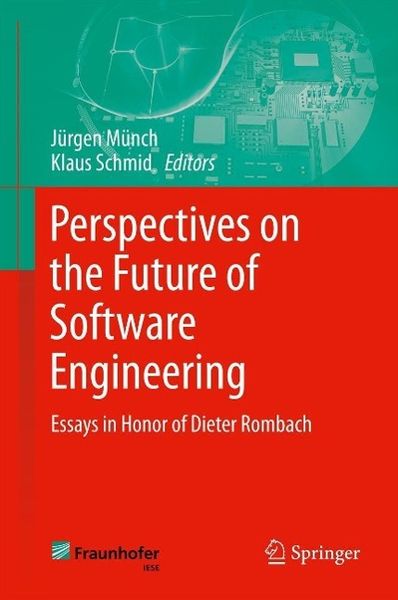
Perspectives on the Future of Software Engineering Essays in Honor of Dieter Rombach
-
- Hardcover
- Taschenbuch
- eBook ausgewählt
-
Form:Einzelkauf Download
-
Sprache:Englisch
96,29 €
inkl. gesetzl. MwSt.Beschreibung
Produktdetails
Format
Kopierschutz
Nein
Family Sharing
Nein
Text-to-Speech
Nein
Erscheinungsdatum
13.06.2013
Herausgeber
Jürgen Münch + weitereVerlag
SpringerSeitenzahl
366 (Printausgabe)
Dateigröße
6621 KB
Sprache
Englisch
EAN
9783642373954
The dependence on quality software in all areas of life is what makes software engineering a key discipline for today's society. Thus, over the last few decades it has been increasingly recognized that it is particularly important to demonstrate the value of software engineering methods in real-world environments, a task which is the focus of empirical software engineering. One of the leading protagonists of this discipline worldwide is Prof. Dr. Dr. h.c. Dieter Rombach, who dedicated his entire career to empirical software engineering. For his many important contributions to the field he has received numerous awards and recognitions, including the U.S. National Science Foundation's Presidential Young Investigator Award and the Cross of the Order of Merit of the Federal Republic of Germany. He is a Fellow of both the ACM and the IEEE Computer Society. This book, published in honor of his 60th birthday, is dedicated to Dieter Rombach and his contributions to software engineering in general, as well as to empirical software engineering in particular.
This book presents invited contributions from a number of the most internationally renowned software engineering researchers like Victor Basili, Barry Boehm, Manfred Broy, Carlo Ghezzi, Michael Jackson, Leon Osterweil, and, of course, by Dieter Rombach himself. Several key experts from the Fraunhofer IESE, the institute founded and led by Dieter Rombach, also contributed to the book. The contributions summarize some of the most important trends in software engineering today and outline a vision for the future of the field. The book is structured into three main parts. The first part focuses on the classical foundations of software engineering, such as notations, architecture, and processes, while the second addresses empirical software engineeringin particular as the core field of Dieter Rombach's contributions. Finally, the third part discusses a broad vision for the future of software engineering.
Noch keine Bewertungen vorhanden
Verfassen Sie die erste Bewertung zu diesem Artikel
Helfen Sie anderen Kundinnen und Kunden durch Ihre Meinung.
Kurze Frage zu unserer Seite
Vielen Dank für Ihr Feedback
Wir nutzen Ihr Feedback, um unsere Produktseiten zu verbessern. Bitte haben Sie Verständnis, dass wir Ihnen keine Rückmeldung geben können. Falls Sie Kontakt mit uns aufnehmen möchten, können Sie sich aber gerne an unseren Kund*innenservice wenden.
zum Kundenservice