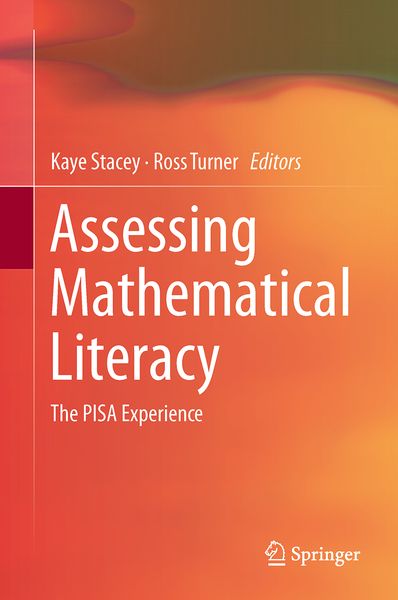
Assessing Mathematical Literacy The PISA Experience
-
- Hardcover ausgewählt
- Taschenbuch
- eBook
-
Sprache:Englisch
95,99 €
UVP
106,99 €
inkl. gesetzl. MwSt.,
Beschreibung
Produktdetails
Einband
Gebundene Ausgabe
Erscheinungsdatum
13.11.2014
Abbildungen
XXI, 321 p. 63 illus.
Herausgeber
Kaye Stacey + weitereVerlag
SpringerSeitenzahl
321
Maße (L/B/H)
24,1/16/2,5 cm
Gewicht
682 g
Auflage
2015
Sprache
Englisch
ISBN
978-3-319-10120-0
This book describes the design, development, delivery and impact of the mathematics assessment for the OECD Programme for International Student Assessment (PISA). First, the origins of PISA’s concept of mathematical literacy are discussed, highlighting the underlying themes of mathematics as preparation for life after school and mathematical modelling of the real world, and clarifying PISA’s position within this part of the mathematics education territory. The PISA mathematics framework is introduced as a significant milestone in the development and dissemination of these ideas. The underlying mathematical competencies on which mathematical literacy so strongly depends are described, along with a scheme to use them in item creation and analysis. The development and implementation of the PISA survey and the consequences for the outcomes are thoroughly discussed. Different kinds of items for both paper-based and computer-based PISA surveys are exemplified by many publicly released items along with details of scoring. The novel survey of the opportunity students have had to learn the mathematics promoted through PISA is explained. The book concludes by surveying international impact. It presents viewpoints of mathematics educators on how PISA and its constituent ideas and methods have influenced teaching and learning practices, curriculum arrangements, assessment practices, and the educational debate more generally in fourteen countries.
Noch keine Bewertungen vorhanden
Verfassen Sie die erste Bewertung zu diesem Artikel
Helfen Sie anderen Kundinnen und Kunden durch Ihre Meinung.
Kurze Frage zu unserer Seite
Vielen Dank für Ihr Feedback
Wir nutzen Ihr Feedback, um unsere Produktseiten zu verbessern. Bitte haben Sie Verständnis, dass wir Ihnen keine Rückmeldung geben können. Falls Sie Kontakt mit uns aufnehmen möchten, können Sie sich aber gerne an unseren Kund*innenservice wenden.
zum Kundenservice