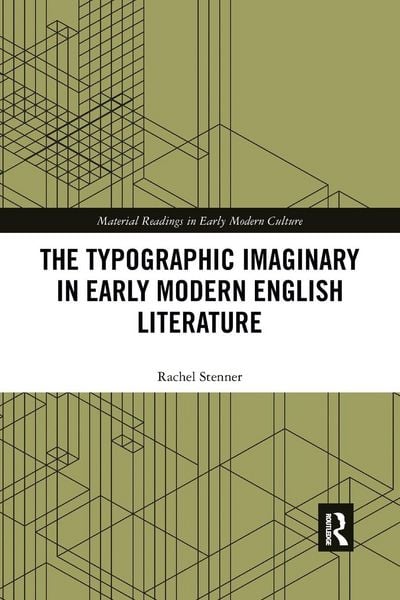
The Typographic Imaginary in Early Modern English Literature
-
- Hardcover
- Taschenbuch ausgewählt
- eBook
-
Sprache:Englisch
72,99 €
inkl. gesetzl. MwSt.,
Beschreibung
Produktdetails
Einband
Taschenbuch
Erscheinungsdatum
31.03.2021
Verlag
Taylor & FrancisSeitenzahl
218
Maße (L/B/H)
22,9/15,2/1,2 cm
Gewicht
323 g
Sprache
Englisch
ISBN
978-0-367-78703-5
The typographic imaginary is an aesthetic linking authors from William Caxton to Alexander Pope, this study centrally contends. Early modern English literature engages imaginatively with printing and this book both characterizes that engagement and proposes the typographic imaginary as a framework for its analysis. Certain texts, Rachel Stenner states, describe the people, places, concerns, and processes of printing in ways that, over time, generate their own figurative authority. The typographic imaginary is posited as a literary phenomenon shared by different writers, a wider cultural understanding of printing, and a critical concept for unpicking the particular imaginative otherness that printing introduced to literature. Authors use the typographic imaginary to interrogate their place in an evolving media environment, to assess the value of the printed text, and to analyse the roles of other text-producing agents. This book treats a broad array of authors and forms: printers' manuals; William Caxton's paratexts; the pamphlet dialogues of Robert Copland and Ned Ward; poetic miscellanies; the prose fictions of William Baldwin, George Gascoigne, and Thomas Nashe; the poetry and prose of Edmund Spenser; writings by John Taylor and Alexander Pope. At its broadest, this study contributes to an understanding of how technology changes cultures. Located at the crossroads between literary, material, and book historical research, the particular intervention that this work makes is threefold. In describing the typographic imaginary, it proposes a new framework for analysis of print culture. It aims to focus critical engagement on symbolic representations of material forms. Finally, it describes a lineage of late medieval and early modern authors, stretching from the mid-fifteenth to the mid-eighteenth centuries, that are linked by their engagement of a particular aesthetic.
Noch keine Bewertungen vorhanden
Verfassen Sie die erste Bewertung zu diesem Artikel
Helfen Sie anderen Kundinnen und Kunden durch Ihre Meinung.
Kurze Frage zu unserer Seite
Vielen Dank für Ihr Feedback
Wir nutzen Ihr Feedback, um unsere Produktseiten zu verbessern. Bitte haben Sie Verständnis, dass wir Ihnen keine Rückmeldung geben können. Falls Sie Kontakt mit uns aufnehmen möchten, können Sie sich aber gerne an unseren Kund*innenservice wenden.
zum Kundenservice